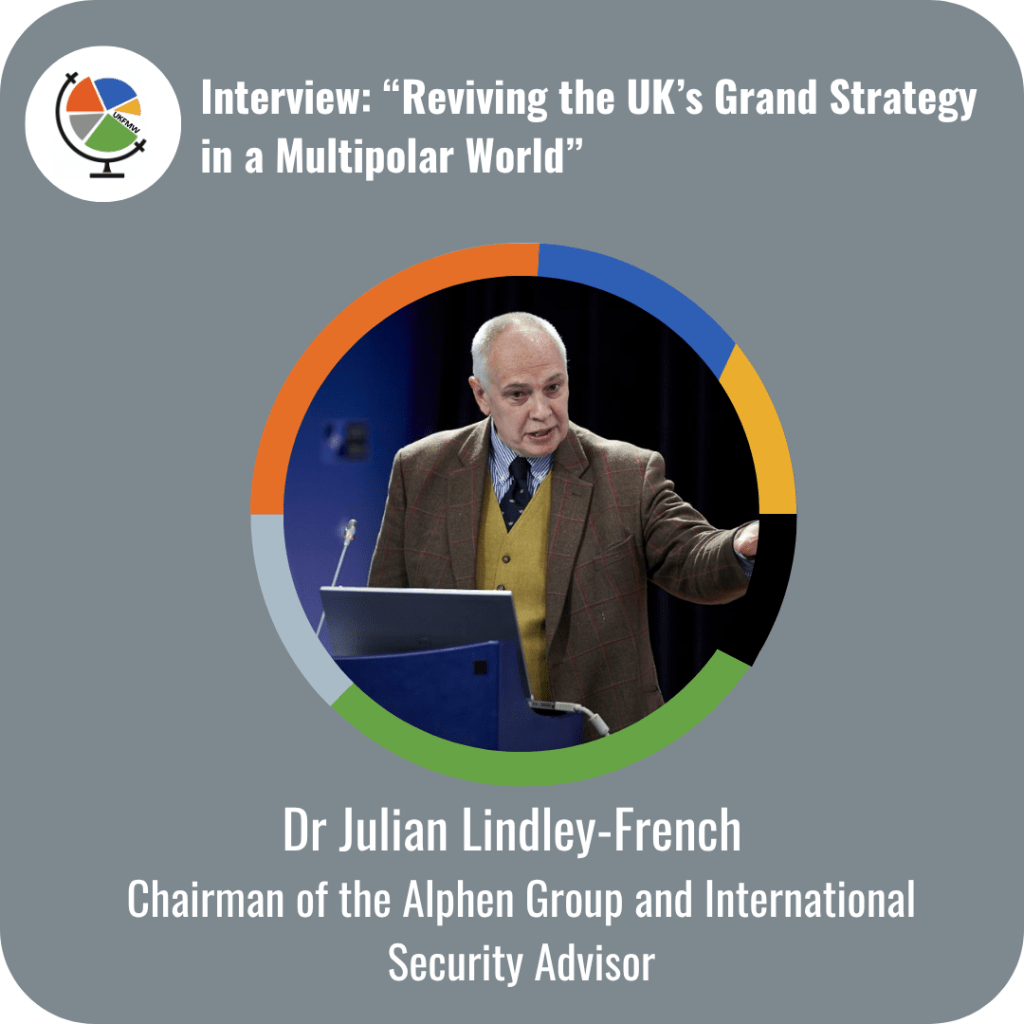
Julian Lindley-French is an advisor on global political strategy and Chairman of the Alphen Group, a network of leading strategic thinkers on transatlantic and European security. His research focuses on the past, present and future of warfare and security thinking, particularly regarding NATO. He has previously held positions as Eisenhower Professor of Defence Strategy at the Netherlands Defence Academy and Distinguished Visiting Research Fellow of the National Defense University in Washington. He has served on the UK Chief of Defence Staff’s Strategic Advisory Group and was Head of the Commander’s Initiative Group for Lieutenant General Sir Richard Shirreff. He has also directed several conferences at Wilton Park. His latest book, ‘The Retreat from Strategy’, co-written with Field Marshall Lord Richards, evaluates the shortcomings of the UK’s current global political strategy amidst instability. In this interview we discussed current problems facing NATO and European countries’ defence and security, and the UK’s global political strategy.
What is the Alphen Group, and what was the inspiration for you founding it?
The Alphen Group (TAG) was created in 2019 in my front room and is a collection of mostly retired senior diplomats, military personnel and other practitioners who have worked together over many years. We wanted to create a platform where we could offer our experience to current leaders, many of whom aren’t steeped in international relations or geopolitics. We have regular meetings, run projects, write articles, and we use it as a way to corral our experience to support institutions. And since 2019 it’s grown much more than we thought it would, which is ageing me rapidly.
It’s been four years since you wrote Future War and the Defence of Europe. Have European countries responded to the technological vulnerabilities you pointed out then?
Europe is still to properly address those vulnerabilities. The reason why is because we talk too much, and having worked for the EU and NATO, I’ve seen it, and I’m part of the problem. We have endless meetings, proposals and action plans, but we never invest the money because its very expensive. And the moment you put investment in emerging technologies off, they just become more expensive, and it’s reaching a point now that it’s too expensive for Europe to afford. I have just been writing a report about this, and I’ve suggested that we need a new ‘lend lease 2’ kind of approach, where half of the amount of money we’re paying to service our national debt is transferred to defence investment, and the rest is repackaged with a longer timeframe. The longer we don’t invest in defence, the more we’re putting people at risk, and we would be as guilty as the aggressor for turning ourselves into prey.
But could we wake ourselves up in time? Absolutely. If you did an audit now of all the technology, talent and infrastructure in Europe needed to modernise defence we could find it all and upscale very quickly. But there’s no leadership on this issue; that’s why it’s not happening. For leadership you need Britain, France and Germany to act together. Germany is showing signs of change, but the UK and France are a mess. In the UK, the defence budget is so tight that we can now basically either afford our own independent nuclear deterrent or a conventional army capable of being a deterrent.
In the book you call for an ‘innovative strategic public-private partnership’ in the defence industry. What do countries like the UK have to do to achieve this?
To understand, we can look back to history at the Shadow Factory scheme in the UK: from 1935, prime ministers Baldwin and Chamberlain may have been appeasing Hitler but, they were also rearming like mad, with one third of industrial production put aside for rearmament.
We actually did this recently with the aircraft carriers, which involved a whole host of companies that hadn’t been involved in defence before, so it just takes a bit of innovation. The main issue is the relationship between the Ministry of Defence and the defence primes. Firstly, MoD civil servants are not very creative when it comes to making defence contracts, and we’ve seen time and time again the huge amounts of money wasted in contracts. The defence primes run rings around the MoD because their goal is to provide profit for their shareholders, not deliver projects. And we can see the effects of this in areas like the Astute Class submarines, which are meant to be brand new but have a whole host of problems caused by the MoD’s inability to take long-term investment decisions. The end result is that we get absolutely nothing for a huge sum of money, and there are many more examples of this. This is all a sign of the UK’s retreat from strategy and the dominance of vested interests over the UK’s grand strategy, which needs to be broken down.
It seems that NATO is now more strained than ever. What has been the impact of the war in the Middle East on NATO relations, and what is the US’s orientation towards NATO now?
Firstly, one needs to distinguish between Trump’s view of NATO and Congress’s view of NATO, as Congress holds the treaty, and Congress has made it clear it supports NATO. We might disagree on a lot, but we still have a lot of use for the Americans.
I’m convinced Trump just approaches everything as a business transaction, and what he’s currently engaged in is a form of armed mercantilism. You have to strip away the strategy and look at the business; follow the money. The question is though, could Trump do so much damage whilst he’s still in office that it fundamentally damages the alliance, or will the US come to its senses and realise it needs allies, especially against the threat of China. By no means do I demonise China: it has its interests that we must respect, and we can engage in candid diplomacy with them, but some in the US administration are convinced of further confrontation with China.
However, Trump’s recent comments about NATO have been very damaging, and I don’t agree with Keir Starmer on much, but I do agree with him that we shouldn’t be dictated to by the US to join a war we’re not involved in. I think right now the US is going through a weird hyper-nationalistic phase. I recently wrote a letter to Tom Hanks, one of the producers of the recent American show ‘Masters of the Air’ about the US Air Force in World War II because the show acts as if the RAF didn’t even exist. It’s a strange attitude in Washington today that the US won everything, should lead everything, and everyone should be grateful, which just didn’t happen. The Americans need to realise they’re part of an alliance of democracies, and if they think they’re going to tell us to rearm and then decide what we do with our new capabilities, forget it. Europe has failed to realise that hard power is not just about defensive capabilities; it is also about influence over allies, and we need to remember that.
Iran’s strategy in this war has been quite effective at undermining the US and Israeli positions. Has it undermined the capabilities that conventional NATO powers thought they had?
Well, NATO hasn’t had much involvement in the war with Iran, so it shows the shortcomings of the US more than anything else. Iran has had years to plan for this and has employed an asymmetrical approach which has been quite effective against the US, but the Israelis are the real winners because they have bumped back the Iranian nuclear programme and destabilised the region with the US’s help.
I can understand why some people might think that Iranian resistance might seem like victory, and in a way it is. But they’re in a very vulnerable position, surrounded by unfriendly states, so the best they can do is employ this regional asymmetric approach. Asymmetry is often spectacular and divisive, but it doesn’t win wars. If you speak to people in the US military, they think that the US didn’t plan this operation and is currently applying its power poorly. The greater danger is the extent to which the US has had to draw assets from the Indo-Pacific for this fight and their use of precision-guided munitions. So the US is now changing its strategy accordingly in the post-warfare stage.
The argument of your book ‘The Retreat from Strategy’ has been brought into sharp focus recently. What are the problems you identify in the book and how have they manifested in the current global situation?
Essentially, the political class in the UK which is responsible for grand strategy has forgotten what it means, and it fundamentally means employing British means on a global scale to achieve British ends. We’ve chosen this path through actions like Brexit, as well as our recent choice of leaders who are less focused on strategy and even less focused on grand strategy. A lot of them have small-island syndrome and think we have very limited power because of our size and position, but that’s not how power works.
Because of this, and the crises that have impacted the British State like the global financial crisis and Covid-19, the state is now scrambling day-by-day to maintain its position. Nobody since Tony Blair has asked the question: what are the fundamental interests of the UK internationally, and how do we realise them? Leaders now have almost lost the ability to think long-term. We’re now in the position where we have an economy 40% bigger than Russia’s, and huge amounts of skills, technical capabilities and institutions, but are unable to harness them for our own interests. Until we abandon the idea that law is an alternative to power, we won’t see Britain playing its rightful role in the world. And when states don’t play their rightful role, it makes the world less stable.
There has been a lot of condemnation about the current state of the UK’s defence apparatus. Can you reflect on the direction the government is now taking towards defence spending at the detriment of other areas?
First of all, there is no strategy as far as I’m concerned. And where is the defence spending increase? I can’t see it. They cut £2 billion from the defence budget this year, and the increase in future spending is a real-terms cut. And secondly, I don’t think there should be any conflict between the Foreign Office as an instrument of power and the MoD as an instrument of power; the FCDO needs investment into it in its own right. The problem is that under Tony Blair we began politicising the civil service, and the quality of the institutions has gone down remarkably; there’s not enough challenge, and we need a serious reform to the entire civil service to return it to its apolitical role in supporting the government.
As for the international development budget, I do not support development with some vague idea about saving humanity. This is an example of the conflation of interests with values, which is what I call value imperialism. For some reason, the UK still thinks that if it shows the world the ‘right’ thing to do, the world will follow. The instruments of power available to us are the tools needed for supporting our interests, and they’re currently not doing it.
I thought this about the Brexit referendum as well. I was never a Brexiteer, and I thought Brexit was bad geopolitics, but having worked for the EU, I saw how it operated through daily micro-compromises which took away the ability of leaders to think strategically. I thought maybe Brexit could mean the UK could start thinking more about its own long-term interests.
Drawing from your work on your upcoming book The Future War in the Pacific, how does China feature in the shifting dynamics caused by the US’s war with Iran?
First of all, the only relationship that really matters now is between the US and China; all other countries are second- and third-tier powers. Secondly, the US will not go to war over Taiwan, and the Taiwanese need to understand that. Most countries have recognised China as owning Taiwan, and we’re not going to go to war over something that actually on paper we agree with.
Then the next question is where does that leave the region more broadly? I for one don’t think the US would go to war over the ten-dash line. Japan might, which could drag the US in, but I doubt it. Another development could be if China, with the help of its useful idiot in Moscow, seeks to dominate in regions like Africa and Latin America, then there’s really potential for a confrontation. In Europe we like to believe there are no longer spheres of influence, but the other powers still see them. The real competition now is to establish the boundaries of spheres of influence between the US and China. This might cause a retreat from globalisation which will create economic problems for China in particular. To avoid this, they need to demonstrate they are a responsible actor, which I think they did during the global financial crisis and Covid. But we need to enshrine the rules of the game in our relationship with China and employ statecraft to make sure we don’t end up in a dangerous arms race or confrontation. My sense is that Beijing is open to this, because there isn’t the ideological underpinning of the Cold War, meaning they’re driven by realpolitik. But some of China’s actions, such as cyber attacks and espionage, are testing Western states’ relationships with China, and they’re willing to respond if China continues.
 UK Forum on a Multipolar World
Leave a comment