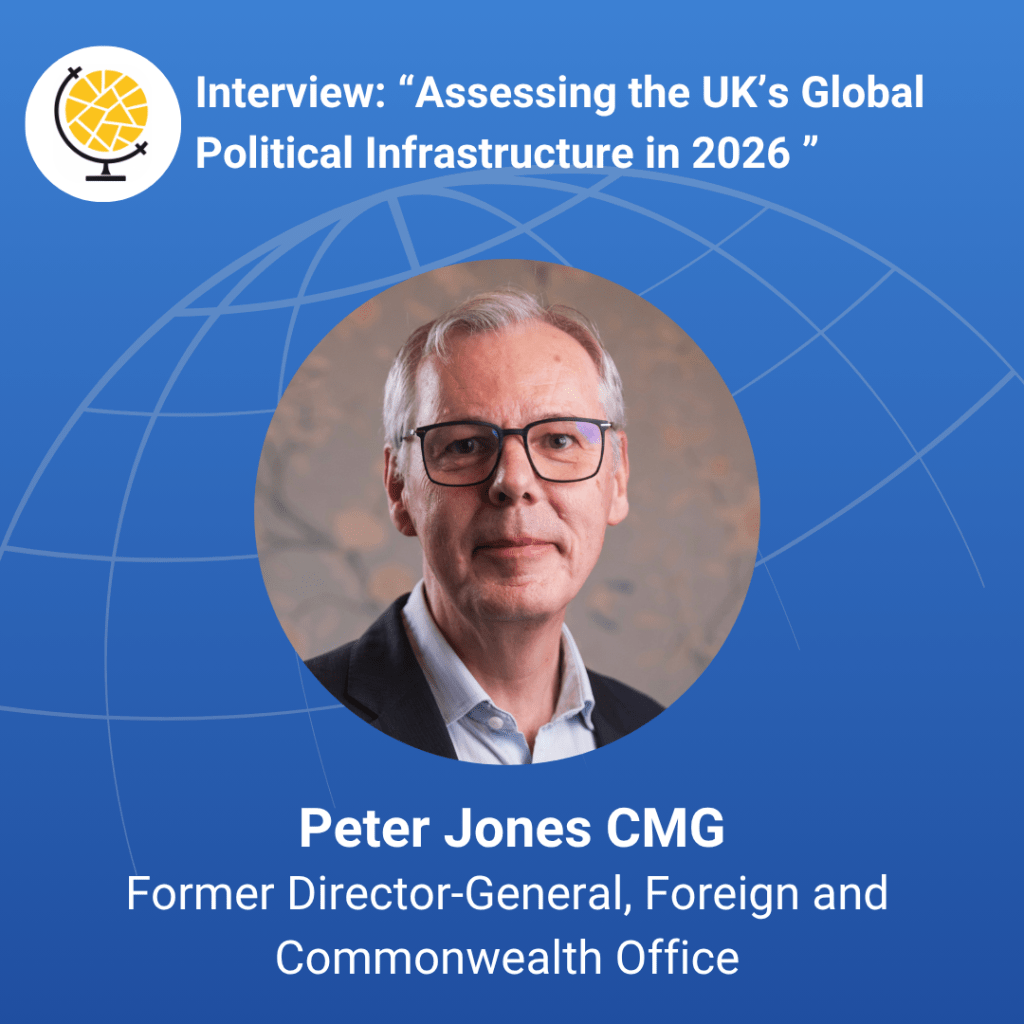
Peter Jones CMG is a former senior British civil servant and diplomat, having served in several senior roles at the Foreign Office, including as Chief Operating Officer and Director-General between 2017-2020. Having left the Foreign Office, Peter now serves as a Visiting Senior Fellow at LSE and the head of LSE IDEAS Global Strategies project. Peter is also a Distinguished Fellow at RUSI, Vice Chair of the charity Mines Advisory Group (MAG) and an advisory board member at the Centre for Political and Diplomatic Studies. Whilst at the Foreign Office, his senior roles included British High Commissioner to Ghana from 2011-2014, and Director for Defence and International Security from 2014-2017. In this interview we discussed the state of the UK’s diplomatic and security apparatus in this period of global instability.
Looking back at your time as Director General of the Foreign Office, could you tell me how complex the Foreign Office is as an organisation and what commentators often misunderstand about it?
There is always something that seems mysterious about a foreign ministry from the outside looking in. A foreign ministry of any significant country has an enormous remit, and the UK is no exception; when I was there we reckoned we were the third most extensive diplomatic network in the world after the US and China, and competing with France, which feels like a good place to be. However, it can sometimes be quite a thin network, and there’s currently quite a large restructuring exercise going on at the FCDO which has been quite challenging.
To boil down the activities of this network, the priorities will always be decided by the minister of state, but more generally they are to promote UK prosperity and security, and of course the important consular dimension of looking after British citizens in that country. And furthermore, the Foreign Office provides the platform for all government operations overseas. When I was COO, one of my jobs was to chair the Network Board, which brings together around thirty departments and agencies in Whitehall that have an international presence, for example the Department of Business and Trade, the Ministry of Defence and the Home Office.
As someone closely involved with the FCO-DFID merger, what are your reflections on that process, what were the driving factors behind that, and what has been the outcome?
For the reason for the merger, you would have to ask the politicians at the time; only they can really say. My personal involvement was actually quite short-lived, as it was announced in the June of 2020 and was to be brought in at short notice. My job was to bring it from the announcement to day one, when a new board structure would be set up. But just getting to day one was very complicated, and we had about 200 tasks to complete, from changing the legal status of the organisation to updating the names on buildings. And then after day one there was still a huge process of change.
Looking back five years later, the process is still going on, and that has informed some of the restructuring going on now. For the colleagues on the development side, it continues to be a very difficult period, not least due to the huge reduction in development spend. It has definitely been a very challenging process, and if you talked to my DFID colleagues, they would stress that strongly.
However, I don’t think it’s necessarily wrong in principle, and I felt this when I was high commissioner in Ghana, where there were development projects being run by DFID which always felt slightly disconnected from the Foreign Office presence. It could sometimes feel that DFID was a bit of an outlier, and bringing the departments under one platform at the point of delivery made sense. That could have been the thinking of the politicians at the time; I can’t say for sure. But I’m not certain that merging the two agencies at the London end was the best idea.
We are seeing a significant restructuring of diplomatic and developmental organisations around the world today. What were some of the global processes that you felt were driving these changes in the UK and potentially elsewhere?
Firstly, there are clearly economic pressures in all directions, and when you have conflict and war overlaid on an already vulnerable system the effects are multiplied, as we can see today. So understanding the economics underneath these changes is key.
I also think the rise of the middle powers; the rise of more countries with more power and more choice about how the world is governed, which you could call the ‘multipolar’ or ‘multiplex’ world as well. For a lot of countries, traditional relationships are being questioned and these rising powers are gaining more choice about how they align themselves. Look at BRICS and the G20, and lots of different minilateral organisations across the world. Look at Europe, all the different ad hoc groupings forming to support Ukraine for example. So, it’s a time of change which is good for those rising powers. But, it’s more complex and more uncertain, and who knows where we’ll be in ten years time.
From your perspective as former director of Defence and Security at the Foreign Office, do you think the UK’s global defence and security commitments are going to have to be recalibrated in this period of instability, particularly in light of recent events in the Middle East?
We have formal moments of recalibration in the form of Strategic Defence Reviews, which usually happen every five years but have recently been more frequent. At the moment, despite the financial pressures, the one area that is promised more resources is defence. However, defence programmes are very expensive, and there will still be some difficult choices to be made despite the funding increase.
Russia’s war on Ukraine is rightly our first priority, and I’m glad the UK has responded to support Ukraine, and I think the future of our neighbourhood will be decided by what happens in that conflict.
NATO is changing, driven in part by pressures from Washington, but those changes were needed anyway. It’s expanding, with the accession of Sweden and Finland, who are valuable partners. And responding to Russia as a regional neighbour will drive a lot of what the UK does with its capabilities in the coming years. But there is a lot to be done overall, and I think despite the extra resources it will be tough to allocate it all well and in a timely manner.
Do you think the current perception of Britain’s global diplomatic commitments and capabilities need to be changed?
Especially in the context of tight resources and the squeeze on the development budget, we do need to think about focus and prioritisation, and although we have a very extensive network, it is very thin in some places. That has always been a debate in the Foreign Office being contested by different factions.
I think one area that does need rethinking is this growing middle-power bracket, which extends to countries like the UK in a way, and we need to think about how we fit into that. Thinking about our partnerships and engaging with other countries in the G20 in a way that looks to the future is important for the UK, and we need to think about creating some new configurations with those like-minded middle powers globally.
Since 2020 there have been a lot of developments that have rocked European security. Have European states adequately responded to the change in orientation of the US towards them?
Obviously it has been a great challenge and a shock to European countries, and there is a large gap between what Trump wants and what exists now. However, things like the Europeanisation of NATO have been supported by both sides recently, so it’s not completely negative. I think Europe has to adapt, including the UK, but that is now going on. Something I saw recently is that it has recently been announced that the three NATO joint force commands will soon all be held by Europeans, which the US has supported. The big thing for Europe is figuring out what to do with this big increase in defence spending, and developing capabilities within Europe that aren’t reliant on the Americans.
How do you think British diplomats today are approaching the question of Europe-US relations?
In a way, the job of British diplomats is the same as ever, which is to promote British values and the national interest. There’s always the fear that we might support the relationship more than the national interest, and in the Foreign Office we used to get messages from above telling us to stop talking about how good our relationships were with countries and talk more about the national interest. That remains the same, it just exists within a more complex environment than there has been in the past.
Could you explain the work that Mines Advisory Group does, and why its work is pertinent to our understanding of global politics?
I’m very proud of the work that MAG and Halo, the other British NGO in this space, do. MAG specialises in mine clearance, and in some countries controlling and reducing small arms and light weapons. The people working at MAG do an incredibly valuable job working on the ground, doing the hard work, sometimes in very dangerous circumstances clearing mines, and their work deserves admiration and respect.
There is something about landmines which is particularly brutal. To start with, they are designed to maim not kill, and disproportionately affect civilians over military personnel, and especially children, as they stay in the ground for decades. For example, we have programmes currently in Southeast Asia clearing munitions that are more than five decades old. And we are still seeing every day the consequences of war decades later.
And the wars we see today around the world are just adding to these problems. One of the things we do in the case of Gaza is risk education programmes, as the danger can be that when people return to their houses after being bombed, they trigger unexploded munitions.
What has been your experience of the relationship between academics and practitioners in foreign policy, as someone who has worked on both sides?
The Global Strategies project I run at LSE IDEAS focuses on connecting academics and their work with Whitehall. So first a confession: when I was an official in the Foreign office I rarely connected with the outside world. The reality was that I was just so busy, and one thing I didn’t understand before joining was just how operationally driven the foreign office is, and it’s just dealing with a succession of issues and problems. I’m glad now I’m on the other side and can do something to connect people.
I think the more you can do to bridge these divides and make connections between academia and government, the better. As we try and navigate the very complex international environment that we have been talking about today, we need to mobilise all the resources we have, especially when nobody quite knows where we’re headed. Other countries I think are better at this, and the American system, although not perfect, but the culture of people coming in and out of administrations, and the ecosystem of think tanks they have, gives officials more time to think and learn, and then come back in. The UK could definitely improve in this area.
 UK Forum on a Multipolar World
Leave a comment