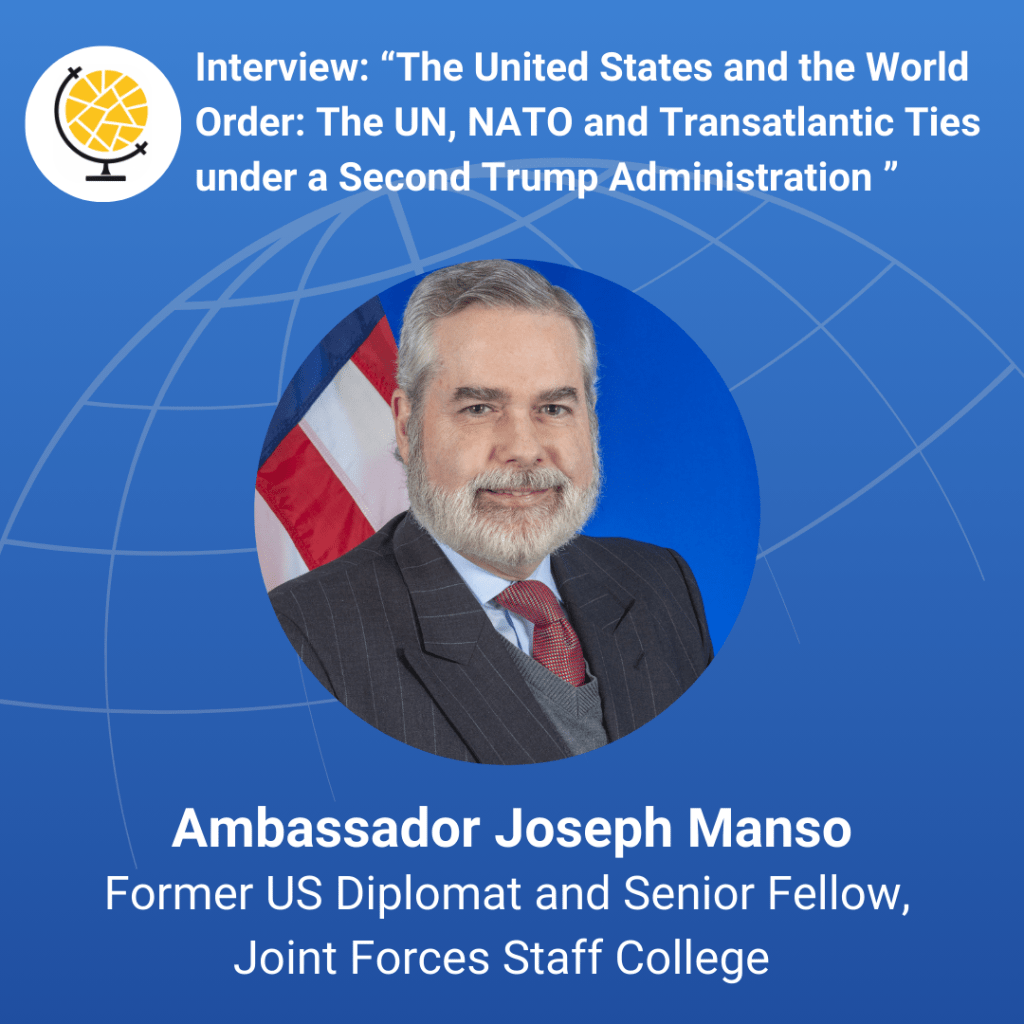
Ambassador Joseph Manso is a veteran diplomat and senior member of the US Foreign Service, having spent thirty-eight years working at the State Department. He is currently a Senior Fellow at the National Defence University, Joint Forces Staff College, and is a Distinguished Fellow at the University of Arizona’s National Security Lab. Beginning his career as a Vice-Consul in Mexico in 1986, he has subsequently served in several senior diplomatic positions, including as Deputy Permanent Representative to NATO, Director of the Europe Bureau at the Office of Regional Political Military Affairs, Director of UN Political Affairs and Deputy Assistant Secretary of State for International Organisations. Between 2020 and 2024 he served as the US Ambassador to the Organisation for the Prohibition of Chemical Weapons (OPCW). In this interview we discussed ambassador Manso’s experience cooperating with international organisations, and the US’s evolving relationship with these bodies in recent years.
As someone who worked extensively with international organisations in the first Trump administration, what was the first administration’s approach to organisations like the UN, and how has that changed?
The United States’ relationship with the UN is extensive, and it was heavily involved with the initial drafting of the UN charter. Despite this, the UN draws a bifurcated reaction in the US, and when people in government asked me if the UN is good or bad, I responded, ‘It is both good and bad.’ It’s true that there is a bloated bureaucracy in the UN, and having worked at the UN headquarters in New York, I saw that firsthand. However, the UN provides essential services all over the world that nobody else would provide, so if we didn’t have the UN, we would need to invent something like it.
So the way I have approached the UN working for the US is by trying to make the good part bigger and the bad part smaller. The current administration has maybe taken this to a more extreme level, but nonetheless it contains the heart of the view that the UN needs reform. Trump keeps saying that the UN has ‘great potential’, and he doesn’t want to withdraw from it altogether, but he is trying to force significant reforms.
What role does the current administration want the UN to play in its international relations or foreign policy?
First of all, the UN is a big animal; you have a lot of different organisations within it, like the WHO and the WFP. The Trump administration has pulled out of the WHO, and their criticisms are legitimate in that China has refused to provide information on the COVID-19 investigation, and the WHO did not push them to release that information. However, the US is not retreating from global health issues altogether, and I should mention that the Gates Foundation, which is a private organisation in the US, spends more on world health each year than the WHO. So the US is committed to supporting world health, but when you have a member state that is not willing to be transparent about a worldwide pandemic, that is a problem.
What is your personal experience of UN organisations in terms of needed reforms? Do you see reform as a matter of survival for the UN?
Let me start off by saying I worked with a lot of terrific, hard-working people at the UN who are dedicated to getting the job done. However, that is a minority of the staff. I remember one project I worked on that involved the deployment of an 1100-person peacekeeping force, and they had six people working on this issue at headquarters, and I asked why they had so few people on the team, and they said they couldn’t find people willing to commit to the project. So there’s a small core of people who are committed to the job and a larger number of people who are just there to be comfortable, and if US taxpayers’ dollars are involved, we are going to need changes. Even the Secretary-General recognises this and has recently announced a 25% cut in secretariat staff and spending and the merger of certain departments. As always, any institution will defend itself and try not to be reformed. So it will be a tough process to reform the UN, and this is also nothing new, as the US has been pushing for reform in the UN basically since the Reagan administration.
What will be the impacts of the US’s current approach on the UN?
You have to be realistic with change, and you’re not going to get there with one step, even if it’s a big one. This is a debate you often hear in the State Department: whether the US is better seeking reform from the inside or outside. We have tried both, and progress has not been as much as we would like. I don’t have any high hopes that the WHO is going to change overnight; it will take time. I think the Secretariat headquarters in New York is reaching a breaking point with the lack of funding, and the Secretary-General may be compelled to make more drastic changes.
I want to underline that I’m not critical of the UN because I don’t believe in it. I think countries are much more likely to engage with and cooperate with an organisation that makes good use of its money and is effective, so these reforms are necessary to promote the longevity of the UN.
Having worked as the director of the European Bureau at the Office of Political Military Affairs, what do you think European diplomats’ reactions have been to the US’s change of stance towards Europe, as expressed by the recent national security strategy?
First of all, just to explain my position as director of the European bureau, this was an office in Washington similar to a ‘desk’ in the State Department that was responsible for NATO, the OSCE and several conventions on arms control. I did also work at the OSCE in Vienna and for NATO in Brussels, so I engaged a lot with European diplomats. In terms of the US’s relationship with Europe, this conversation is not new, and we have been asking European countries to spend more on defence for decades. I worked at the State Department for 38 years, and we were constantly asking for more defence spending. This administration has taken a more undiplomatic tone, but they would argue they are getting more results. The tone is not what diplomats would recommend, but the policy has effectively been the same since the 1950s.
Some European countries, such as France, are now advocating for Europe to have a more independent defence system and to create their own ‘pillar’. I don’t necessarily disagree with this, but it would require much more defence spending in order to become independent. I just think it’s a tragedy that it took something as horrifying as what’s happening in Ukraine to wake up our European allies to the need for defence.
How much weight do you give to the argument that European states are now upping defence spending not just because of Russia but also because of a potential threat from the US?
I would say it is not a realistic concern that Europe is under threat from the US, but I can understand why Europe may think the US would no longer guarantee their security. Look, Europe is a mature democratic society, and it is more than capable of making its own decisions on defence. I think it is a good thing that Europe has finally woken up to its own vulnerability and the need for greater defence spending.
I also want to praise our Danish allies who are exceptional and who have contributed tremendous efforts to our alliance and who may feel underappreciated now. There are many people in the US who value Denmark’s contributions, and it’s unfortunate that our policy has been stated in such a rough way towards Denmark. They are justified to have some hurt feelings, and they are really underappreciated.
I would also say that as a diplomat you need to be looking five or ten years ahead, so these issues are not just about the current administration, which will end soon. We need to look at the broader interests of the US and Europe, and I think that staying united is always in our interest – the democracies of Europe and North America are safer together – and these interests have a way of manifesting themselves in the longer term.
As someone who has worked at the heart of NATO, what was your experience of collaboration with NATO allies, and what was the sense of the US’s role in NATO?
NATO is an interesting contrast to the UN in terms of institutional structure. NATO requires consensus to make decisions, so all allies have to agree. This is for a good reason because these decisions are life and death, and no country is expected to send people into combat without agreement. The fact that NATO is so effective and reactive is testament to the close values and interests that its members hold. That’s not to say there are no disagreements, and I have spent many hours in windowless rooms trying to come to agreements on certain things.
Whilst I was there, a major theme was that many of the western NATO allies were reluctant to do anything that would provoke the Russians, whereas the Eastern European allies were constantly pointing out Russia’s aggressiveness. This came into focus in 2014 when Russia invaded Crimea and the Donbas. Following this, the eastern allies were immediately ready to deter further aggression, whereas the western allies were more cautious. This discussion came to an end in 2022 when Russia invaded again, and now all NATO allies agree on the need to deter Russian aggression.
In terms of the American role in NATO, it’s very interesting. The Russians would always describe NATO as a tool of the US, and it’s true that the US has great influence in NATO, but believe me that the other allies are not shy in sharing their views. The Russians think NATO is like the Warsaw Pact, where whatever Russia said was agreed upon. Whereas in NATO the allies are allies, and we debate things with each other. So the US does have influence and resources, and it plays a leadership role, but nonetheless the other allies are vocal and aren’t afraid to question us.
Could you explain the function of the Organisation for the Prevention of Chemical Weapons (OPCW) and what you did there?
The OPCW is a treaty organisation with over 190 members with the function of implementing the Convention Prohibiting the Use of Chemical Weapons. This means that countries cannot manufacture, stockpile or deploy chemical weapons, and the OPCW has an inspectorate to inspect chemical facilities globally. They also have an investigative team to look into potential uses of chemical weapons, notably in Syria in recent decades. There is also a more positive side, which is the promotion of the peaceful uses of chemistry and developing chemistry infrastructures globally.
This is a specialised international organisation that is doing very good work, with a lean and effective secretariat and strong support from many countries around the world. The work of an ambassador at an organisation like that is to build coalitions, working with a wide range of countries to improve processes and get results through inspections of incidents. The most important thing in this role is to understand the positions of other countries, which allows you to make compromises and build those coalitions.
Some commentators have argued that there is more continuity with Biden’s foreign policy in the current administration than recognised because of the inevitability of the pressures on the US. Would you agree with this?
There has definitely been a change; there’s no denying that. But I think the media often fixates on things that have changed rather than the continuities, which is part of the nature of the news. So, although it is not covered in the media, there is a lot of continuity in US foreign policy, and this is because of the realities of politics and geography. You don’t want to get lost in the daily headlines that only emphasise the change and ignore the continuities. It is still very much in the interest of the US to maintain its alliances, like Europe, as well as the interests of those European countries.
Reflecting on the recent Davos meeting and the discourse arising from it, and as someone who has worked with organisations central to the world order of the last seventy years, do you agree with this assessment that we are now in a new era of great power rivalry?
I think that we are in an era of great power competition, but that doesn’t mean we can’t preserve parts of the rules-based international order. At the end of the Second World War, the US was very generous; it helped establish these institutions of the international system that did require a certain burden to be put on the US. And now that Europe and Asia are rebuilt and wealthy, those allies should shoulder some more of the burden of these institutions that were created to support them. I think part of the reason you have this current administration is because of the resentment the US feels for having to support these institutions.
Having said that, Europe wanting to be strong and independent is a good thing for the US, and a Europe with an independent defence system that can work with the US or other allies would be a stabilising force in the international order. So I would not talk about a rupture; I think that is premature. I would talk about an evolution of the international order with countries that have not been contributing previously now stepping up in the system.
What are your thoughts on how the nature of diplomacy has changed?
I think technology constantly changes how diplomacy is practised, but the essential nature of diplomacy is always the same. You could read a diary of a seventeenth-century French diplomat, and what he says about diplomatic negotiations is absolutely relevant today. Diplomacy is fundamentally about human nature and understanding your counterparts. Since the invention of the telegraph, people have been predicting the death of diplomacy, but the truth is that personal contact, relationship building and trust are still the foundation of diplomacy.
 UK Forum on a Multipolar World
Leave a comment