By Deiniol Brown
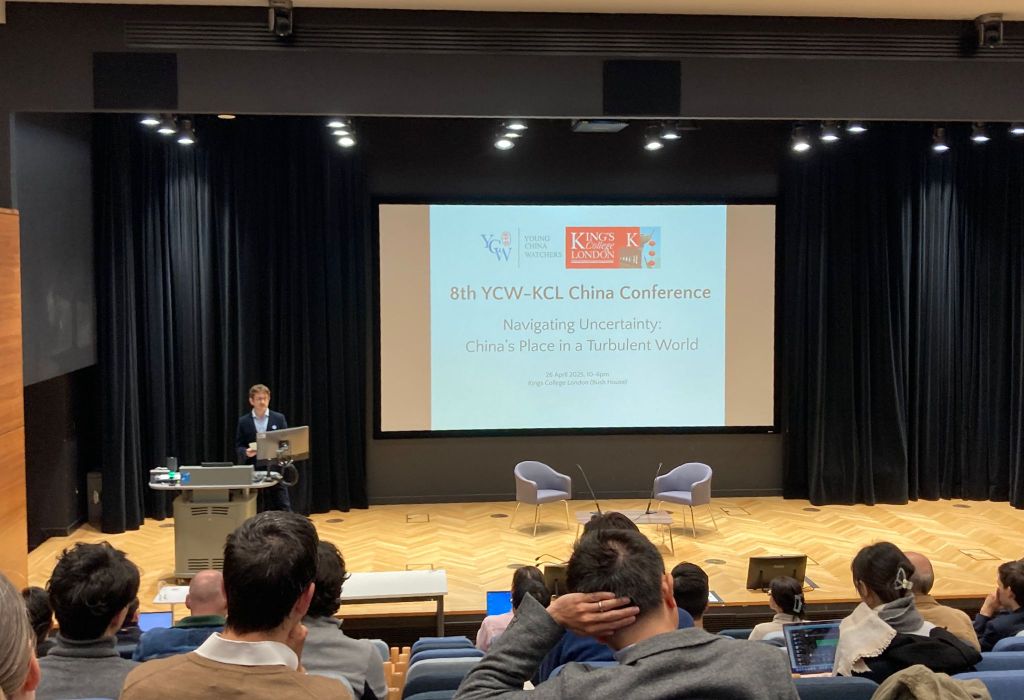
On the 26th April, I attended the Young China Watchers’ annual conference held at King’s College London, which included a series of speeches and discussions aimed at exploring China’s global political relevance, and relation to the UK. Speakers included former minister Anne-Marie Trevelyan, the Economist’s defence editor Shashank Joshi, and a host of other researchers and specialists in UK-China relations (more can be found on the YCW website). The event provided an excellent chance for reflection on China and the UK’s place in the world, considering the turmoil brought by the re-election of Donald Trump. Without revealing the specific speakers’ positions, I hope to lay out the different directions of thought on these issues in the room through this article.
UK and China
First of all, regarding the UK and China’s direct relationship, there is clearly still a divide between those who regard China as a fundamental strategic and moral threat, and those who see it as more multidimensional; both potentially a threat and an opportunity. It is undeniable that China’s ideology and state structure lie in direct contrast to many of the UK’s core values, and to some this precludes the possibility of meaningful long-term cooperation. China’s occasionally assertive international relations, subversive business practices, and curtailing of freedoms pose a definitive barrier to closening ties for many people.
The event also focussed on China’s complicated situation regarding its domestic economy and society, and the structural issues of unemployment, housing market collapse, and overbearing state-led industry. However, there was some cause for positivity, as the UK and China’s shared interests around education, and synergies in industries like luxury goods and manufacturing, demonstrated both the capability and the need for collaboration. The mutual diplomatic respect that both states have for each other, and the commitment to cooperation through a variety of forums was also a valuable, if understated, point. Ultimately, the majority of speakers reflected the interdependence of these different positions; that we are both opposed to, and intertwined with China, and the UK’s strategy seems to be to restrict them whilst also cooperating with them in different areas.
Triangulating
This mixed picture of ideals and approaches outlined above is somewhat complicated when taking into context the broader position of China and the UK in the world. On one level, the stakes of the ‘China threat’ have heightened in the 2020s, with its enabling role in Ukraine, and its increasingly aggressive stance on Taiwan. However, the huge impact of the US’s dramatic change of foreign policy, and its enormous ramifications for the global economic and political system, was also widely discussed. The consensus was that this threw the positions of many countries into question, none more so than in Europe, where states are now under potential threat of invasion from Trump’s America, leaving them with a serious dilemma. Almost everyone agreed that the UK, in this context, will broadly stand by its European allies in a united approach.
This seemed to raise three potential trajectories for European states’ relations between the US and China. First, in order to maintain Europe’s critical alliance with the US, European states could compromise on global trading relations and their commitment to liberal internationalism, decoupling with China and pandering to Trump. Second, Europe may attempt to balance between the US and China, hoping to maintain cooperation with China, particularly around global institutions like the WTO, despite the tensions and imbalances in their relationship. Third, that Europe might continue to decouple from China, whilst also distancing itself from the US, instead trying to pursue an independent path. The voices in the room seemed to suggest that this final option was economically unfeasible, with Europe lacking the capital and the capacity in key industries like manufacturing, defence and tech. However, most people were also incredibly reticent to submit to Trump’s demands, or to move substantially closer to China, demonstrating the depth of this dilemma.
In a situation such as this, dialogue and relationship building are low-cost and effective ways forward that doesn’t increase vulnerability. Any balance that Europe seeks to strike between the US and China will need cooperation between many different actors and interests across multiple regions. Although many still see China as opaque and unpredictable, this conference demonstrated the real potential in engaging in pragmatic discussion around mutual interests and values, and the significant space there is for cooperation. Reaching out to China diplomatically could be a great way to manage the UK and Europe’s economic needs, security concerns and political disorientation, as it clings to a disintegrating liberal world order.
 UK Forum on a Multipolar World
Leave a comment