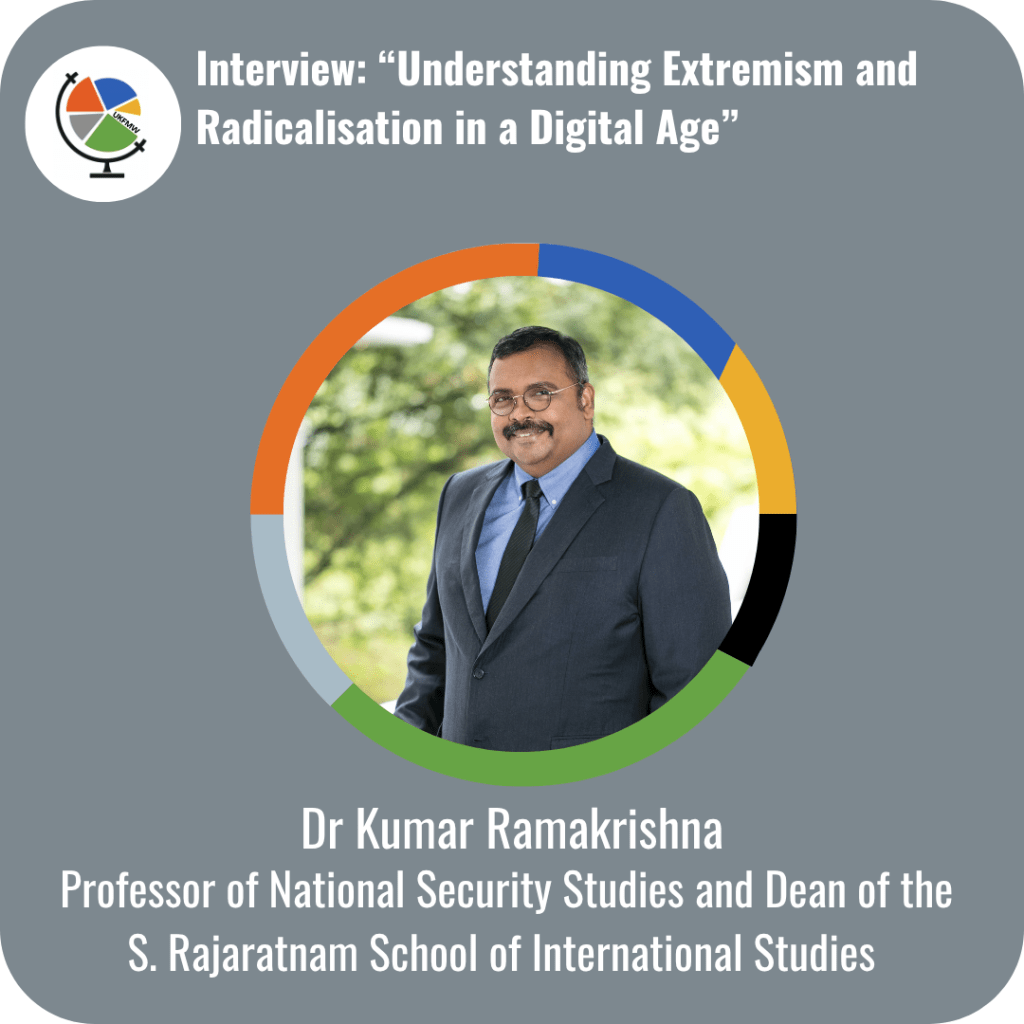
Dr Kumar Ramakrishna is Professor of National Security Studies and the Dean of the Rajaratnam School of International Studies at Nanyang Technological University. Dr Ramakrishna’s research focuses on extremism and counter-terrorism, as well as strategic thought, with an emphasis on Southeast Asia. He has previously held many academic and professional posts, including as a Visiting Fellow at the Institute for National Strategic Studies at the National Defence University in Washington DC, and as a Special Visitor to the Australian Department of Foreign Affairs and Trade. He is currently a Senior Research Fellow at the Centre for the Resolution of Intractable Conflict at Oxford University, and a Senior Advisor at the Concord Foundation. His most recent book is ‘Jemaah Islamiyah, ISIS and Beyond: Tracking the Evolving Challenge of Violent Extremism in Southeast Asia [2001-2025] (2025)’. In this interview we discussed the evolution of extremism amidst technological advancement, and the changing nature of international conflict.
What are the drivers of the emergence of extremism in Southeast Asia, and how did it develop compared to other regions?
Firstly, I will refer to my recent writings on the evolving research of the International Centre for Political Violence and Terrorism Research (ICPVTR) here at RSIS. ICPVTR’s research tracked closely the development of political violence in the region in the over twenty years since the Al Qaeda attacks in New York and Washington. Taking a long perspective on political violence in the region, I have argued that the first major concerns arose from the communist insurgency in the region in the 1950s and sixties, and the threat of the Communist Party of Malaya (CPM). This threat lingered until the late 1980s, and since the September 11th attacks in 2001, it has been replaced by the threat of transnational Islamist terrorism, led by the likes of Al-Qaeda and Islamic State.
My recent writing traces this threat from Islamist terrorism in the region from the early 2000s, when organised networks of terrorist cells were established across the region, including in Singapore. And following the establishment of ISIS in the mid-2010s, as well as the global rise of social media and online radicalisation, terrorism became more diffuse from those initial organised cells, to include lone wolf attacks and more disparate groupings. This has been one of the major developments since 2001. The second major and much more recent development has been the rise of white supremacist extremism, where even in Singapore there have been – unexpectedly, it should be said – cases of radicalisation by White Supremacist and related ideologies. This is a developing issue, and we are closely watching how it develops at the ICPVTR.
In the current climate, Islamist extremism has seemingly fallen off the top of the agenda for states like the UK. What is the current state of the threat it poses?
I would agree that Islamist extremism is no longer the priority in countries like the UK, or in Southeast Asia, or even in the USA, especially as white supremacist extremism has become more impactful. However, we cannot minimise the prevalence of Islamist extremism, which has certainly been boosted by the Hamas attacks in Israel on October 7th 2023 and the ensuing massive Israeli military response in Gaza that has resulted in much civilian suffering that has been amplified by social media worldwide, including in Southeast Asia. Keeping in mind that Southeast Asia has 20-25% of the world’s Muslim population, these recent events have had a big impact on societies, including in Singapore, and have driven radicalisation.
Some far-right ideas have also had big impacts here. For example this ‘great replacement’ theory, which originated in France in 2012 and has been reproduced by far-right movements across the world. Some of these ideas have even been adapted to and customized for Southeast Asian audiences, such as the example of “East Asian supremacy” rather than White Supremacy as in the West, for instance, making the threat picture much more complex. The picture has also been complicated by recent events in Iran, which is a social media war as well as a real war, and will definitely contribute to radicalisation around the world.
How does Singapore approach the issues of extremism and radicalisation?
I see Singapore’s approach as a combination of hard and soft approaches. The hard approach is having strong laws against terrorist activity, having a strong internal security apparatus, and having strong laws against terrorism-related activities and the spreading of ill will between different groups in the country. The soft approach is the initiatives that promote cohesion and unity between different ethnic and religious groups in the country. There has always been a concerted effort to stress that Singapore is multi-ethnic and multi-religious, and that all religions have a place here. There have also been public education initiatives like SG Secure, which spreads knowledge and teaches skills about dealing with terror incidents to the public. There is a whole host of public policies designed to make sure that all Singaporeans have a stake in the country.
Following 9/11, there was an Al-Qaeda plot uncovered involving a cell in Singapore belonging to a pan-Southeast Asian and Al Qaeda-linked terror network called Jemaah Islamiyah, which also led to new policy initiatives by the government. For example, the Inter-racial religious confidence circles (IRCCs), where there are committees from various ethnic and religious groups designed to increase harmony between groups. These types of community initiatives means that, in the event of an emergency people know how to cope with it. Following this plot, a group of volunteer and independent Muslim scholars in Singapore formed the Religious Rehabilitation Groups (RRGs), which helped to reach out to and rehabilitate radicalised individuals, which have been very successful. So these examples show how Singapore blends hard and soft approaches, and several countries across the region have followed a similar if not identical strategy.
What is a ‘Salad Bar’ ideology, and why is it important for understanding radicalisation today?
Until recently, you could tell easily what ideology people have been radicalised into. However, since the rise of social media and the variety of ideologies on there, the ‘salad bar’ radicalisation phenomenon has developed. This is when someone is radicalised with a mix of ideologies, often haphazardly borrowing ideas from Islamist extremism, white supremacy, misogynist ideology and others. In Singapore, we had our first ‘Salad Bar’ radicalisation case last year, where a boy was influenced by ‘incel’ ideology as well as other far-right ideas and some Islamist ideas too. So, I would not be surprised to see many more of these cases going forward across the world with social media playing a larger part in young people’s lives.
How do you think AI will further affect how radicalisation works?
This is a very important question, as AI and emerging technologies further complicate the picture of information and influence online. We have already seen that AI is disturbingly effective in promoting misinformation online, for example through deepfake videos. This is very concerning to counter-terrorism and security officials, as the final trigger for violent action may actually be constructed by AI, and not even exist in the real world. AI could definitely continue to fuel extremism and will make it even harder for counter-terrorism practitioners and analysts to understand how these processes function and develop online.
Could you explain the concept of the ‘indirect strategy moment’ in international relations from your recent article?
The reason I wrote this article is because I realised that if you look at global politics right now, there are a lot of undeclared wars going on, with state actors trying to undermine other state actors through indirect and unconventional means. To illustrate, for many years, until its February 2022 invasion of Ukraine, Russia had been accused of undermining not just Ukraine but other democratic systems in Europe through disinformation, cyber and other “hybrid” means, and people have talked about concepts like ‘grey zone operations’ to explain this. Other countries have increasingly engaged in similar actions as well around the world. The aim of such an “indirect strategy” is, as the 5th century Chinese strategist Sun Tzu, put it, to ‘always avoid enemy strength and target enemy weakness’. If you adopt this lens, you can find that this ‘indirect strategy’ has been used a lot in recent decades. It has been adopted as doctrine, for example Russia’s Gerasimov doctrine, or China’s ‘unrestricted warfare’ strategy, which all talk about a wider set of instruments beyond just military power, to impose their political will on another state. Traditionally, the largest component of a conflict would be military, whereas now, under indirect strategies, it has become informational or economic.
 UK Forum on a Multipolar World
Leave a comment