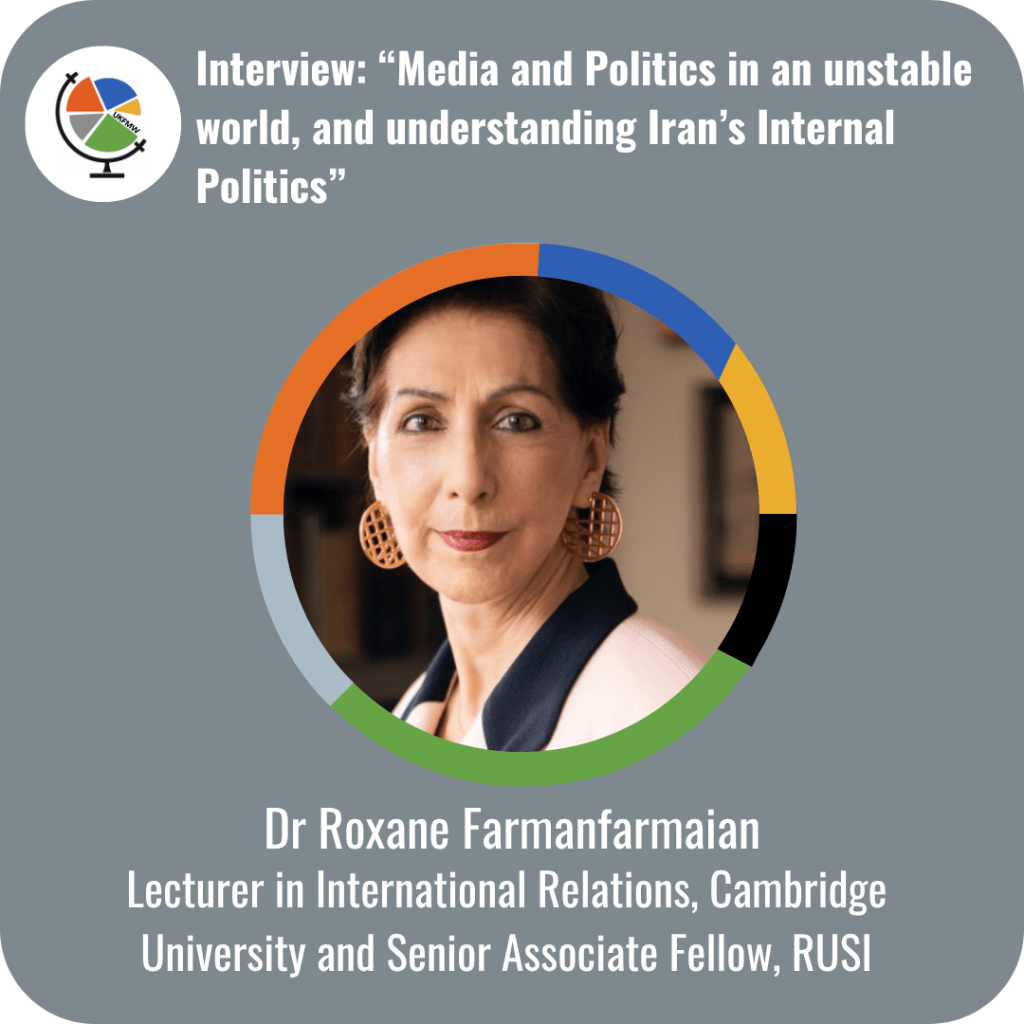
Dr Roxane Farmanfarmaian is an affiliated lecturer at the University of Cambridge’s Department of Politics and International Studies and director of international studies and global politics at the University of Cambridge Institute for Continuing Education. Drawing on her career as a journalist, her research focuses on media and politics in the Middle East in local contexts and their impact on international relations with the region. She has written extensively on international relations and media, such as ‘Media in the Maghrib’ and ‘Iran’s Rhetoric Aggression: Instrumentalising Foreign Policy Through the Media’, and previously served as the editor of the Cambridge Review of International Affairs. Dr Farmanfarmaian is also a senior associate fellow at RUSI. In this interview we discussed the media’s impact on politics around the world and recent events in Iran.
Media is often seen in the ‘west’ as inherently democratic and liberalising. Is that perspective accurate, and how can we better understand the media’s impact on societies in different contexts?
In the West, we can often see the media as something that is very liberal, that opens spaces and questions the government. First of all, I think we don’t realise how much our own media in the West is constrained. For example, the government itself controls the content and format of information that is released and who is allowed access to that information first. Our media can be very manipulated, and it has its own forms of censorship. There has been a lot of recent debate about the coverage of the Israel-Gaza conflict, for example. Another illustration of this I have been seeing recently is the reporting on the January protests in Iran and the fact that the reporting on the death toll there has not been debated like other conflicts have.
When we look at media in countries like those in the Middle East that are autocracies, we need to recognise that the media itself is having to constantly fight for its status and its own existence. Secondly, in these states whole systems of coding and referencing have developed for the media to communicate to the population in that context. Looking from the outside, western observers often can’t recognise these dynamics and therefore misunderstand the communication. Often, audiences inside a country can get a lot more from that media than we can from the outside.
Can you reflect on how our understanding of the media’s relationship to politics have changed since the 2011 Arab uprisings?
In this period, I was looking at media landscapes in North Africa and Turkey, and one thing I saw was a rise in Islamic media in this period. The Islamic media fills a whole different part of the landscape compared to what we see as media in the west, and it interacts with a whole different system of norms and social systems. That has only continued to grow in the Middle East and elsewhere.
And I think our own media has shifted significantly since then in response to economic pressures, such as lots of private equity involvement in the sector in recent years. Often the result is that those who take over are part of an economic elite that is closely tied to the political elite, so one result is that there is less breadth for independent voices. For example, in the Pentagon, a lot of independent media is being sidelined, and media that are more pro-government have been given more opportunities to cover breaking news. That too is narrowing the bandwidth of different voices and perspectives. Overall, I would say this is not a good time for the media, and another disturbing aspect to this is the targeting of journalists in war zones, with Israel now killing more journalists than any other state in modern times, which is probably reflective of a trend in other war zones too.
Do you think politicians or governments, for example, in the UK, adequately understand the centrality that media now has for global politics? What should politicians do to better approach the issue of media in foreign policy?
I think one thing we are seeing is that the explosion of social media and now AI is leading to a real war of narratives, which is complicating things both domestically and internationally and causing a lot of upheaval in media landscapes. This has caused several issues for politicians, polarising the relationship between politics and the population but also making the practice of politics harder. New media can make pursuing policies much harder, as small issues can easily be politicised and dominate the narrative and take on a life of their own.
One of the issues we’re seeing right now is that the media narratives on the relationship between the ‘West’ and the Middle East are becoming increasingly bifurcated, and the understandings of the situation in the two places are diverging. Facts themselves are becoming increasingly frail, and a population can now be convinced that something is true regardless of the reality on the ground.
We’re now seeing moves by some governments to curtail the role that social media plays in our lives, such as Australia banning social media for under-16s. How do you interpret this movement in relation to social media as a political force?
I think I fall on both sides of this argument. On the one hand, I think social media has been an amazing tool in broadening information access and provision, and it has added dimension to the media landscape. However, it also has negatives which are serious and compounding. As a professor I find it very difficult, because I want young people to use tools and have access to these platforms, but it has also been very destructive and has a lot of highly negative impacts on people’s lives. This is a delicate balance, and young people’s access to this technology does need to be looked at carefully, but I have mixed feelings about banning access completely.
I think a lot of the political issues in recent years have exposed the shortcomings of both traditional media and new media and pitted them against each other. What do you think will result from this contest between the two forms of media? Will legacy media be left behind totally?
As a scholar I try not to be in the prognostication business. First, we should take a step back. Let’s look at the Ukraine war, for example; this is one of the first theatres where manipulation of social media and narratives has been at the centre, and this conflict has changed the nature of war globally. Similar changes are happening outside of warzones too, and there is going to be as fundamental a change outside of the battlefield.
Another issue is simply the quantity of media out there today in its different forms, and this makes some level of siloing inevitable as there is just so much more to choose from. I think one thing that is still very valuable about legacy media is that it provides a diverse variety of curated media sources. Some legacy media outlets, therefore, are essential in maintaining that difference and disagreement in the media landscape. The media is fundamentally a reflection of our world, and therefore that difference in opinion and perspective is crucial.
Now looking at the recent events in Iran and your writing on it. How important have US pressure and international interests been for motivating the recent protests in Iran?
That’s a very big question. The messaging and political pressure from the US on Iran have been very confusing. Some of it was focused on human rights as the main issue, despite the administration having recently sent Iranians home from the US in shackles. Trump is also saying his primary concern is Iran’s nuclear programme, contradicting his other messaging. Trump clearly walked away from the negotiating process – which according to media accounts had resulted in Iran offering him a deal that would have halted their stockpiling and reintroduced full inspections, with some analysts saying it was an even better deal than Obama negotiated in the JCPOA (the 2015 nuclear deal). Instead, he chose war, and from what we can gather from the media, it resulted in a more complicated and drawn out war than the US had planned, Iran’s closure of the Strait of Hormuz affecting the global economy with long-term impacts on energy as well as food.
Dealing with a strong but volatile character like Trump has added a whole new dimension to foreign policy. But whether the US’s foreign policy is being well run or if it gives options to the Iranian regime to cooperate is not clear. Where does this leave us as observers? It really leaves us in the dark; we can see that there is a lot of power being deployed here, but we can’t see a plan or a clear argument being made.
In your article for RUSI you write that recent protests have been a rejection of the theocratic architecture in Iran, but from a position of national identity. Could you explain this dynamic?
Polls for years have shown that Iran is the least religious Muslim society in the Middle East. That at the very least suggests that there’s a disconnect between the population that does not practise Islam in an institutionalised way and the government that claims to be religiously based. Another question to be asked is whether the government is indeed a religious one, or whether it is a simple dictatorship parading as a theocracy. Scholars have argued that the revolution itself was led by a core of religious believers, but when Ayatollah Khomeini died, the theocracy also died.
On the other hand, I think it is not true that Iranians want outsiders to influence their next steps. And in the war that broke out in June, called the twelve-day war, the US and Israel thought the decapitation of the Revolutionary Guard Corps and the targeting of some key sites would cause the regime to collapse. This didn’t happen at all; there was a rally around the flag, and there was real horror that Iran had been attacked and a thousand people died. Iranians then rallied around the flag, not of the Islamic Republic, but of their collective feeling as Iranians.
Now, the January 2026 protests in Iran, which US Treasury Secretary Bassent admitted triggering by manipulating Iran’s currency, sparked a group of bazaris selling mobile phones to go into the streets to protest about the economy. This led to protests across the country, which were also further propelled by the activities of foreign contributors like Mossad, which clearly indicated on its Farsi X feed that it would be helping the protests. This is worrisome, not just in relation to those protests, but to what might follow the end of the war – the arming of different factions inside Iran by outside powers to trigger a broad breakdown of law and order, governance, and security.
As an Iran watcher, what struck me was the violence of the January protests, which was very uncharacteristic of protests in Iran previously. Although often ill-understood outside Iran, government responsiveness in the face of demonstrations, which tend to relate to sanctions and economic issues, has been pragmatic, and usually has been accompanied by economic relief packages. This was also seen in the Women, Life Freedom protests where, although the government never publicly admitted it, it backed off from insisting women appear in public with the veil, and many women now don’t wear one in the streets. So as Iran watchers, we couldn’t understand the nature of the protests and the violence that we saw. The regime clearly felt more threatened by those protests – it saw a linkage between the protests domestically and the threat from abroad, especially as both Trump and Israel’s Netanyahu were calling for the Iranian people to rise against the government – and that’s what led to the brutal clamping down on the protests at such enormous cost to human life.
 UK Forum on a Multipolar World
Leave a comment