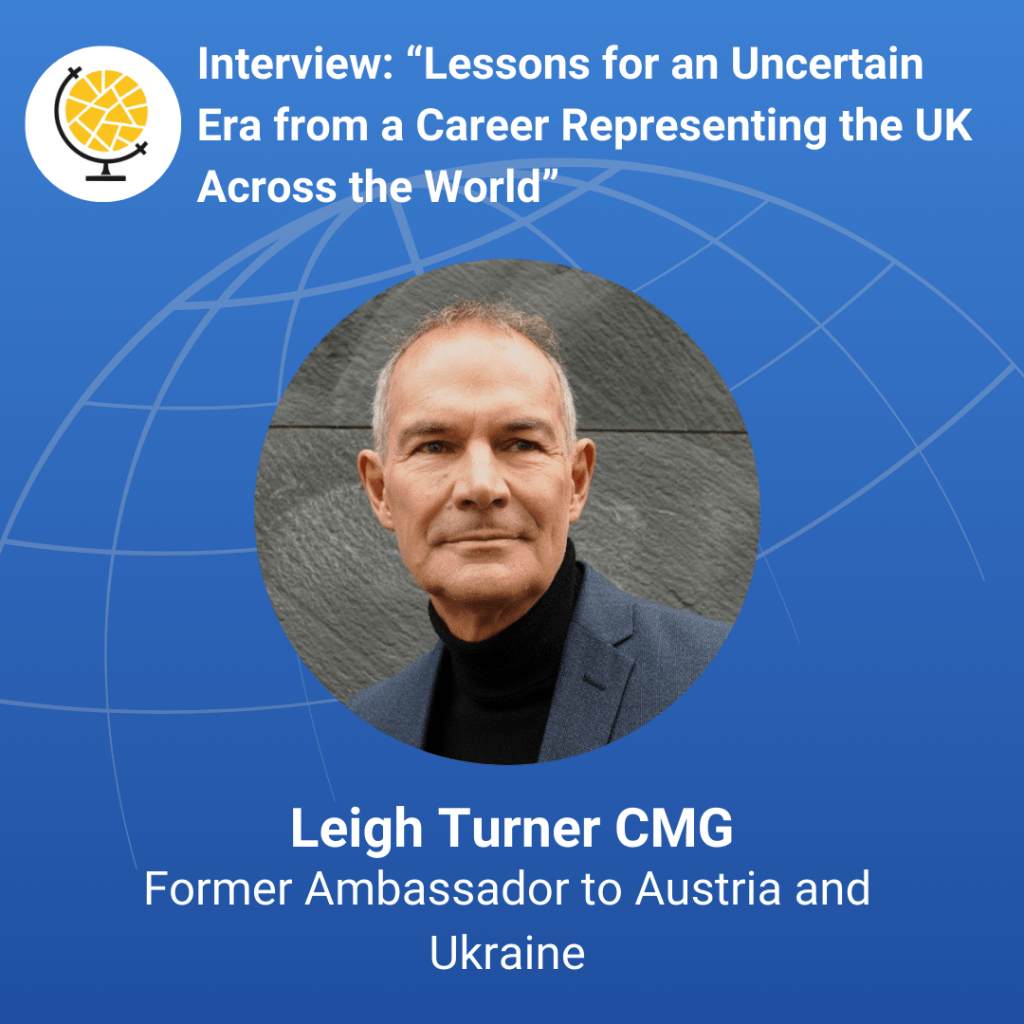
Leigh Turner is an author and retired senior British diplomat, having most recently served as British Ambassador to Austria and Permanent Representative to the International Organisations in Vienna. Ambassador Turner served in several other senior roles at the Foreign Office, including Consul-General and Director-General for Trade and Investment for Turkey, South Caucasus and Central Asia in Istanbul, Ambassador to Ukraine, and Director of British Overseas Territories. He has published several fiction and non-fiction books, including several thrillers and short stories. His latest publication in 2026, Seven More Hotel Stories, is a collection of short stories inspired by real events. Turner has also written about his time as a diplomat, including his book Lessons on Diplomacy, published in 2024, which provides fifteen lessons for aspiring diplomats. In this interview, we discussed Leigh’s perspective on the UK’s international relations in the context of its overseas territories and the relationship with Turkey. We also explored his insights as Ambassador to Ukraine in the years before Russia’s invasion of Crimea, as well as the current state of the FCDO.
Firstly, reflecting on your role as Director of British Overseas Territories, what role do the UK’s overseas territories play in its international relations and foreign policy?
I think it’s illustrative to consider the Falkland Islands (Islas Malvinas in Spanish), which is a small territory in the South Atlantic with a population of about 3,000 people. Before 1982, the Falkland Islands were not really on people’s radar in the UK. And before the invasion, the UK had been talking to the Argentines about resolving the dispute over the islands. Nobody expected the invasion in 1982, which was driven almost entirely by internal Argentine politics. The principle of sovereignty, that these islands are British, was very important to the British government, so they sent a task force to reclaim the islands.
I mention this because there was really no strategic value to the Falkland Islands, which is the case for nearly all the overseas territories today in the twenty-first century. It is really the principle of self-determination that is keeping them as part of the UK’s overseas territories. Some are really small like Pitcairn, with a population of fifty, and others are larger like the Cayman Islands, with a population of over 50,000. These places are only overseas territories because the people there want to remain. The UK doesn’t even make money from these places; they don’t receive any tax receipts from places like Bermuda. Rather, they cost the UK taxpayer money e.g. for disaster relief.
There are a few exceptions to this, which are South Georgia and the British Antarctic Territory, which have no population, and the British Indian Ocean Territory which has a large US base there, but has limited strategic value to the UK. There has been a lively controversy over this territory, with the UK government’s recent decision to cede the territory to Mauritius who have been campaigning for this alongside the evicted islanders for many years.
Whilst you were in that role, what did you spend the most time working on and what issues did you face?
There’s a chapter in my book Lessons in Diplomacy that is titled ‘How to Deal with a Legacy of Colonialism’, and this looks at the overseas territories and their quite unique constitutional contexts. Most of my time in the role was occupied with future constitutional arrangements, with each territory having its own constitution, set of laws and level of autonomy. Each constitution has been negotiated separately with the United Kingdom, and this is an ongoing process that I dealt with. There is a lot of debate about the status of overseas territories, on the international level at organisations like the UN, but also within the territories themselves. For example, I remember going to Montserrat and having a debate with people on the radio about the future constitutional arrangements of the territory. Some people would like to be independent, and I encourage that, but most people so far have preferred to remain overseas territories because of the benefits such as disaster relief and access to living in the UK.
Now looking at your time as Consul General in Istanbul and Director of Trade for Turkey, the South Caucasus and Central Asia, what was your understanding of Turkey’s role as a regional actor whilst working there, and how has the UK’s relationship with Turkey developed in recent decades?
I would say the relationship between the UK and Turkey has been quite fluid. It’s always interesting to see the perceptions that people have of the UK in their country, and in Turkey the perception has been massively shaped by the First World War when the UK tried to invade Turkey in 1915. After the war the British actually occupied Istanbul, and the Treaty of Sèvres was signed which would have effectively destroyed Turkey. This treaty was resisted by the Turkish leader and father of the nation Atatürk, and this period very much shapes Turks’ view of the UK. There is even a saying in Turkey that if two fish are fighting in the Euphrates then it’s because a British person has walked past.
Until the 1980s or 1990s, Turkey was largely inward-looking and didn’t engage much internationally. However in the 1990s, Turkey’s economic renaissance led it to engage more internationally and led to an effort by the UK to improve relations. I think this has been reasonably successful, there has been some cooperation on defence, and on bilateral investment which was a large part of my job.
The economic success of Turkey has also allowed it to rebuild its military capabilities, which have had an impact in the region. For example Turkish Bayraktar drones have been widely used in the Armenia-Azerbaijan conflict and the Russia-Ukraine conflict. In a sense Turkey has been flexing its muscles as an independent player in the region, such as through its mediation in Russia’s invasion of Ukraine, and being relatively friendly with both sides. On the whole, many people would say this slightly autonomous role has been positive, and it has been successful at balancing being an independent regional player with its commitments to NATO.
Having served as ambassador to Ukraine between 2008 and 2012, what pressure was Ukraine under from Russia then, and what was its relationship with Russia and the West?
I have some familiarity with Russia and Ukraine, as I was also posted to Moscow from 1992 to 1995 as First Secretary (Economic). When I was ambassador in Ukraine, its relationship with Russia was tense at times, but also close. There was a good degree of exchange and understanding, the rights of Russian speakers in Eastern Ukraine were protected and there was an amicable relationship; for example it was common to hear exchanges on the radio where one person was speaking Russian and the other Ukrainian. The idea that there could be an armed conflict between the two was slightly extraordinary. Even at that time though, there were critics that saw Russia as being able to pose a threat to Ukraine.
When I arrived in 2008, things started to change with the Russian invasion of Georgia. Despite the onset of the war being unclear, Russia did then occupy a large part of Georgia before retreating. This put the wind up a lot of people in Ukraine, as they saw invasion as possible there too, especially in Crimea which Russia had long claimed. At the same time, many people were not concerned because of the treaty signed in 1997 between the two countries, where Russia recognised the territorial boundaries of Ukraine, including Crimea as Ukrainian territory. There was a movement in Ukraine to seek closer ties with NATO at this time, with them applying for membership in 2008 but being turned down for fears of NATO members provoking Russia. With hindsight, this was probably a mistake as Russia went on to invade Ukraine six years later.
At the time, there was also an effort made by European countries to invest in Crimea, which was a comparatively poor region, in order to make it more pro-Ukrainian. I remember visiting as part of an EU development project to install water and electricity in a small village. However this was not enough, and Russia invaded in 2014 and has now annexed it as Russian territory. For a more up-to-date reflection I have a chapter in “Lessons in Diplomacy” on Russia’s current invasion of Ukraine.
In Lessons in Diplomacy, your chapter ‘How to Make Diplomacy Reflect a Changing World’ reflects on how diplomacy is practiced. Could you reflect on how the practice of diplomacy has changed throughout your career, and the impact this has had on politics itself?
Well, diplomacy is constantly changing and many things have changed fundamentally since I started in the eighties. For example, when I started, the Foreign Office had a monopoly on encrypted communication, and if you wanted to send an encrypted message anywhere you needed to send it via the communication centre in the Foreign Office. This has now changed utterly as all smartphones can send encrypted communications, can translate messages and lots more.
However, I do think some aspects of diplomacy will always remain the same. One aspect of this is having expertise on countries, cultures and languages. A second thing is a focus on people; diplomacy is very much about listening to people, understanding people and communicating those things well. You need to be able to see the other’s point of view and understand what they want in order to cooperate.
Another thing that has changed fundamentally is the role of women and under-represented groups in the Foreign Office which was very limited when I started. Since then we’ve had two female ambassadors in Beijing for example, which is a very welcome change.
There is a lot of discourse about the FCDO at the moment and the UK’s capacity to conduct diplomacy. Could you evaluate where the Foreign Office is currently in these terms?
I discuss in the book that there have always been reforms at the foreign office, so one could say ‘it was ever thus’. But at the same time, I think the instability that we’ve seen at the Foreign Office in the last ten years has undermined its effectiveness. For example, in the years following 2010, there were all sorts of efforts to cut the funding of the Foreign Office and make it more streamlined. And then in 2020 it was announced that the international development work of the government would be merged into the Foreign Office, which damaged the morale of both departments and consumed large amounts of energy. Added to that, we had Brexit taking place, which created a lot of work in damage control for the Foreign Office. So the combination of cuts, the merger and Brexit, and now this new round of cuts, speaks to a loss of stability in the British Foreign Office which is damaging to that organisation and to the UK as a whole. I’m hesitant to criticise the Foreign Office because I know there are a lot of brilliant people working there, and it’s traditional that retired diplomats complain that things were better in the past, but I think it’s clear a bit more stability is really needed in the Foreign Office now.
 UK Forum on a Multipolar World
Leave a comment