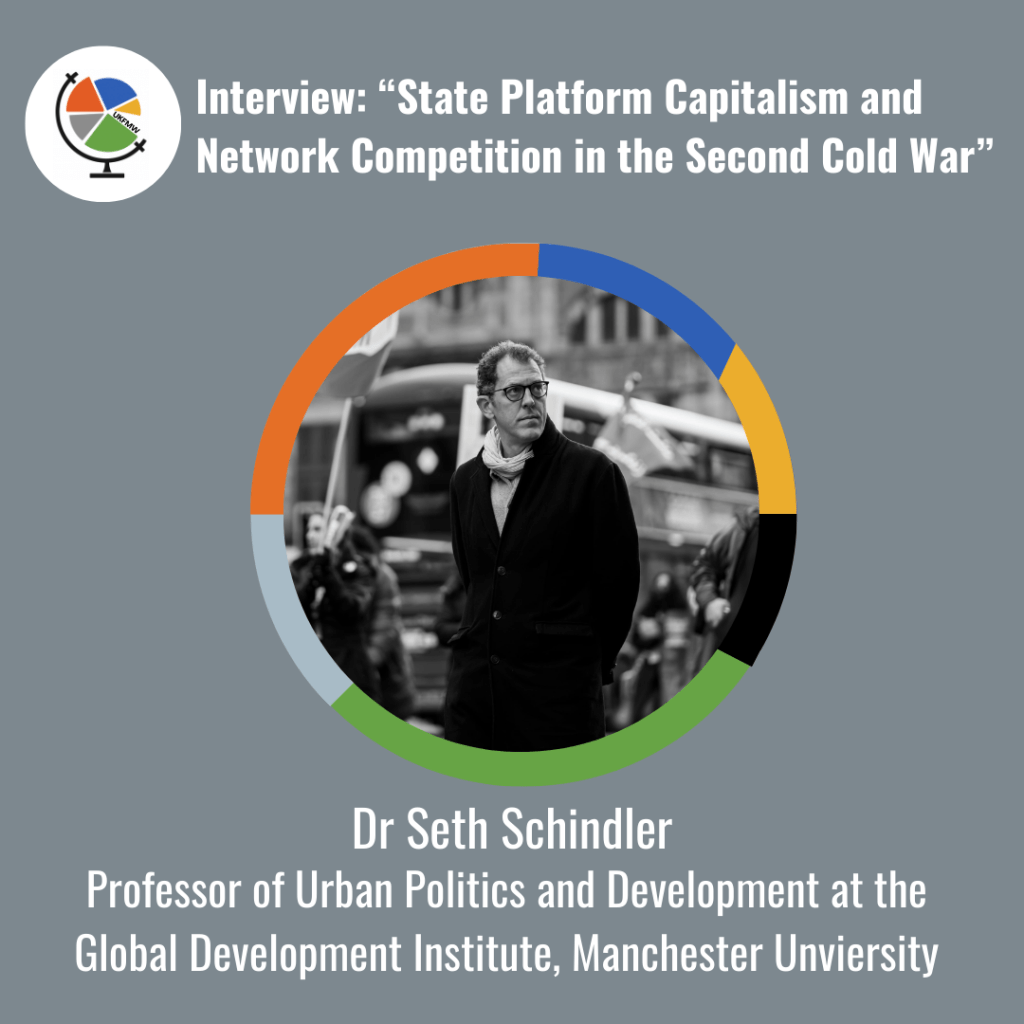
Dr Seth Schindler is Professor of Urban Politics and Development at Manchester University’s Global Development Institute. Dr Schindler’s research focuses urban and regional transformation initiatives in the context of broader economic and political transitions. Schindler is also the co-founder of the Second Cold War Observatory, a collective of scholars researching the nature of great power rivalry through research on different environments and societies around the world. His latest book, titled ‘State Platform Capitalism: The United States, China and the Global Battle for Digital Supremacy’, co-authored with Steve Rolf, explores the importance of digital platforms in global competition between the US and China. In this interview we discuss the Second Cold War in the context of recent events, and the impacts of rivalry on third countries.
In an article in 2021, you talk about how many states are reorienting towards ‘infrastructure state’ institutions, driven by US-China competition. But it seems that European states have largely not followed that trend. Why is that, and where does Europe fit in this new logic?
This article came out of a meeting in Beijing with my two co-authors, where we were each working on different countries (Tanzania, Nepal, and Laos) but seeing similar processes of restructuring with states trying to take advantage of the Belt and Road Initiative (BRI). These countries are historically weak states, with recent instability in all of them, and to absorb the benefits of the BRI they needed to reform their institutions.
This is generally not the case in Europe because the states already have well-developed bureaucracies, and China is not very active in Europe in terms of infrastructure projects because Chinese firms often fail to receive tenders from European governments. For example, there was a case I studied in Turkey where a railway was funded by the European Investment Bank (EIB), and therefore had to conform to European standards, and Chinese firms hoping to build this railway failed to meet the standards, although one ended up working in a consortium with an Italian company. So I don’t think the framework of the ‘infrastructure state’ can apply to many European countries, apart, perhaps, from some on the periphery like Serbia.
Is this resistance to restructuring in Europe an advantage or disadvantage in the current global economy?
It really depends on what the objective is. European states don’t face the same infrastructural deficit as emerging countries which were forced into structural adjustment by the IMF in the 80s and 90s, and who had their public spending restricted. Most European countries haven’t faced that, apart from some states like Greece and of course drastic reforms were enacted in countries that were in the Eastern Bloc. Developing countries that did undergo structural adjustment struggled to attract investment in infrastructure and many exhibit a very real infrastructure deficit. This goes for the two countries we write about in the article, Laos and Nepal. Both are very attracted to China’s offerings of high-speed rail and other infrastructure, that they would be absolutely unable to build another way. By comparison, Europe doesn’t have an infrastructure deficit.
Your concept of the ‘Second Cold War’ focuses largely on US-China rivalry’s manifestations globally. However, is this rivalry inherent? Could the US and China cooperate rather than compete to advance their power?
Certainly conflict is not inevitable, and there could be an accommodation between the US and China as seen in the 70s in the first Cold War. However, at the moment I don’t see any way for the countries to come to an agreement, for the reason that both are committed to political projects that are mutually exclusive. Trump’s “Make America Great Again” project is a conservative, restorative project that requires the reassertion of American power globally, and Xi Jinping’s “rejuvenation of the Chinese nation” and “China Dream” campaigns are similar in being restorative and backward-looking. These visions cannot both be achieved simultaneously, and therefore rivalry will be unavoidable on the global stage. One of these needs to change course in order to avoid competition.
Can you reflect on the changes of the last twelve months in the context of the Second Cold War, particularly in light of the discourse coming out of Davos recently?
The last twelve months have been a bit of a blur in terms of global politics since Trump’s second term. However, I would say there’s some continuity as well. The Biden administration really picked up where the first Trump administration left off. The first Trump administration fundamentally changed US foreign policy towards China, and the 2017 National Security Strategy was the first one since 9/11 that identified great powers as the main threat to the US rather than non-state actors. However, the first Trump administration failed to articulate a clear foreign policy programme, because a lot of people in the administration were still supporters of neoliberal globalisation. And then under Biden, a constituency of China hawks really gained influence over foreign policy, which continued Trump’s focus on great power rivalry.
The Biden administration introduced programmes that encouraged local governments to partner with private firms on industrial projects that would bolster national security. These schemes also funded projects designed to foster a green energy transition and 40% was supposed to go to historically underprivileged communities. This really maintained that idea of a restorative project in the US. So I don’t think that Trump’s second term has changed that significantly, other than eliminating the EDI and green energy aspects of Biden’s policies. He is pursuing ‘military Keynesianism’, with an emphasis on high-tech industries like AI, and the US government is increasing cooperation with private firms in Silicon Valley. So there have been a lot of events in recent months, but there is plenty of continuity in the ‘Second Cold War’ as well.
With regard to Mark Carney’s speech at Davos, this is confirmation to me of how people are now thinking about the economy. Prior to Trump’s return to office, a lot of states, especially in the North Atlantic, positioned themselves closely to the US in the Second Cold War. But now I think European states are much more cautious and are trying to balance their relations with the US and China which is what we have termed ‘polyalignment’. This contrasts the idea of ‘non-alignment’ that we saw in the first Cold War. Rather than being non-aligned to either power, countries are now trying to expand their relations with both the US and China. This is especially evident for countries in the global south. Carney’s speech expressed this polyalignment, and we can see Starmer’s visit to China as an expression of this too.
As the digital aspect of the Second Cold War intensifies, what are the threats to countries like the UK, which are wedded to US digital platforms? Are there alternatives to US and Chinese platforms?
I’ll first explain our concept of ‘State Platform Capitalism’ that we use to look into this competition. The phenomenon of digital ‘platforms’ is a recent trend; for example a company like Uber which provides a platform to connect taxis with customers. It doesn’t sell anything, but it brings buyers and sellers together on its platform. Some of these platforms are so large that they seem too large to regulate; I mean, how could the UK regulate Google? This view is captured by the notion of ‘platform capitalism.’ However, at the same time, following the global financial crisis we saw the re-emergence of states as market regulators and participants, with states investing a lot in companies. People like Ilias Alami have characterised this as ‘state capitalism’. There is an apparent contradiction between these terms – are platforms too big to regulate, or are we in an era of state capitalism?
What we found in the case of the US and China, who both have these extensive ecosystems of digital platforms, is that the platforms and states are cooperating. Both Washington and Beijing are mobilising platforms for geostrategic objectives. Platforms have established monopolies over functions in the economy, affording them a lot of structural power. They do not operate free markets, rather, they can determine how and by whom their platforms are used, and they can block adversaries from significant segments of the economy. States are keen to wield this power, or at least wield the threat of weaponising platforms.
And what about other countries, and how exposed are they? If we just left this issue to market forces, states would like to use both US and Chinese platforms, combining US software with Chinese hardware. The UK was one of those countries until recently, which had Huawei infrastructure as the backbone of British Telecom, but now they have decided to strip that infrastructure out due to the political pressures and the perceived threat that Huawei poses. Countries are now being pressured to choose between the US and China’s digital infrastructure, for example in Ecuador, where the US offered to pay all of the country’s debts incurred to China in exchange for Ecuador removing Huawei from its telecom infrastructure. Most countries, which are polyaligned, want to combine different hardware and software into a diversified ‘stack’, but this is becoming harder.
Another good example is the Chinese platform ‘LOGINK’, which is used for running port logistics all over the world. The US has identified LOGINK as a major security threat, which is interesting because it’s not posing a direct military threat, but instead by having these ports integrated on a single platform, China has a view of the global economy the US lacks. This is especially threatening to the US because it integrates digital and infrastructure networks. This locks countries into Sino-centric networks.
Looking at the concept of state platform capitalism, one aspect which I find missing is social relations as a part of platforms, and how platforms are interrelated with social orders. What are your thoughts?
I think there are a variety of approaches and objectives pursued by states under the new structure of state platform capitalism. States are using these platforms to pursue those objectives in ways not possible under neoliberalism. In Quinn Slobodian’s book ‘Globalists’ he talks about the two pillars of neoliberal ideology: free markets and electoral democracy. He describes markets as being ‘encased’ by institutions to stop democratic forces from ‘distorting’ them. That is why we’re now seeing this ‘take back control’ movement globally as a reaction to neoliberalism.
That firewall between democracy and free markets has been thoroughly eroded. During the Biden administration, Jake Sullivan, the national security advisor, gave a speech outlining the US’s geoeconomic strategy, stating that the US believed in free markets but was going to protect strategic assets in a ‘small yard with a high fence’ using export controls and tariffs. This meant that the US government was going to be heavily involved in certain sectors to protect its interests, which is the opposite of neoliberalism. The firewall is no longer between domestic politics and the market but between US economic interests and market forces – in these sectors the US Government will pick winners. In my view, neoliberalism really ended then and there.
It’s anyone’s guess what the social impact will be, but what we need to look at is how democratic demands will shape the economy in a way now that they couldn’t before.
Could you explain the Second Cold War Observatory and what it does?
The Second Cold War Observatory (SCWO) started very informally, when I had a few PhD students working on questions related to how geopolitics is manifesting in regional and urban areas. The conversation continued with me and Jessica DiCarlo and some other colleagues and we ended up publishing the ‘Second Cold War’ paper.
At the same time there was a debate going on amongst foreign policy elites in the US about whether the term ‘Cold War’ was appropriate for the US-China rivalry. We found this debate tiring because those commentators couldn’t bring themselves to see the Cold War and current US-China rivalry as part of the same process. Instead, they were debating whether ‘Cold War’ was an appropriate analogy for the present. As we explain in the paper, it’s much more of a continuation. Contemporary geopolitical rivalry differs from the Cold War, sure, just as WWII is different from WWI, but they are events in a series. Commentators close to the US establishment can’t accept this interpretation because it undermines the idea that the US unambiguously won the first Cold War.
China challenged the US in the 50s, as the junior partner in the East Bloc. After the Sino-Soviet split, some American analysts considered China the primary threat, and so did the Kremlin. The normalisation of relations between the US and China brought that chapter of the Cold War to a close, but China is now renewing its challenge to US hegemony.
In the observatory we have colleagues from around the world committed to taking a long-term view, and interpreting contemporary geopolitical rivalry as part of a global process. Furthermore, our members are committed to understanding how this geopolitical rivalry plays out in different environments around the world. In March we have a conference about cities and urbanisation in the second Cold War, and then in April we have a conference on geopolitics and development in my department at the University of Manchester.
 UK Forum on a Multipolar World
Leave a comment