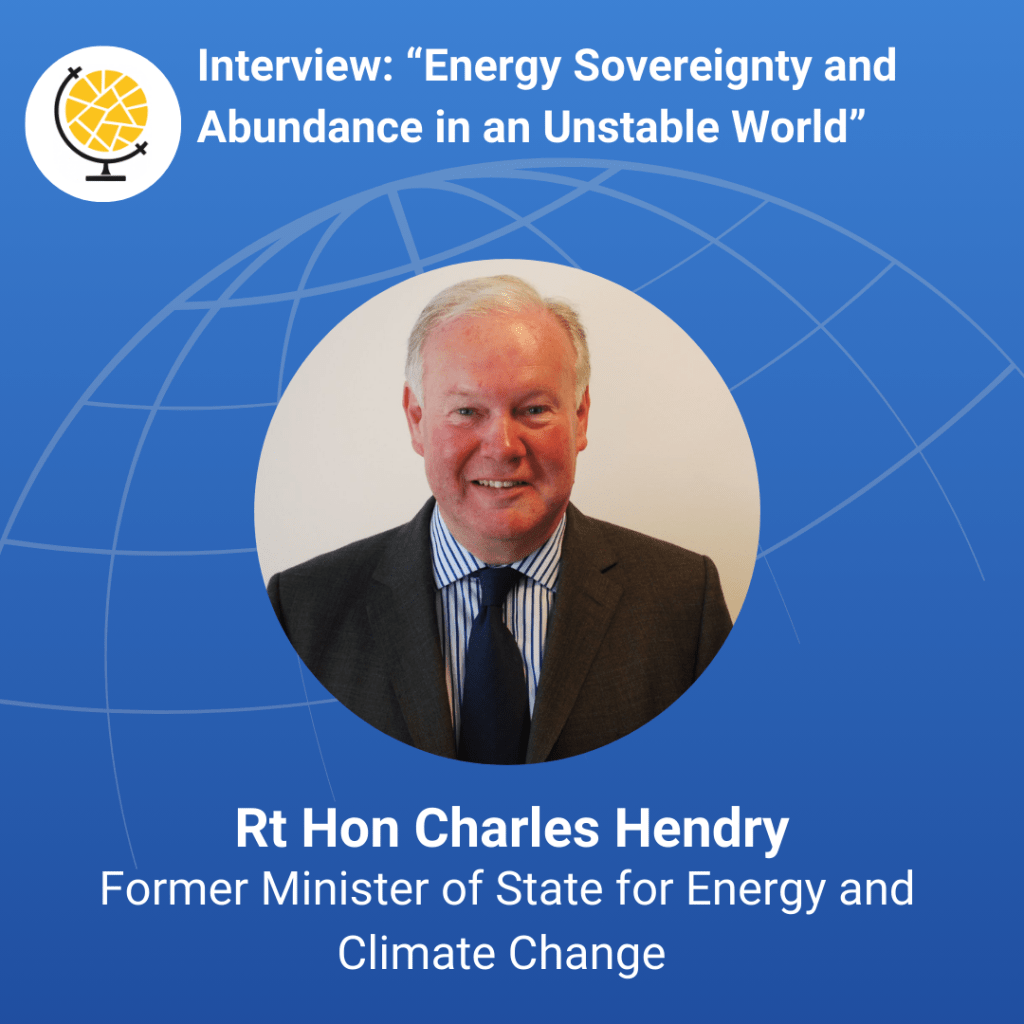
The Rt Hon Charles Hendry is a distinguished fellow at the Atlantic Council and former Minister of State for Energy and Climate Change. A conservative MP for almost twenty years, Mr Hendry has extensive experience in government, serving previously as the PPS to the Minister of Social Security and the Minister for Education and Employment under John Major, before returning as Energy Minister in the coalition government. He subsequently served as the Prime Ministerial Trade Envoy to Azerbaijan, Kazakhstan and Turkmenistan before stepping down as an MP at the 2015 election. Following this, Mr Hendry has held many positions, serving as the Chair of the British Institute of Energy Economics until 2024, the Vice President of the Energy Institute, and the patron of the Nuclear Institute. He was also appointed an honorary professor at the University of Edinburgh Business School. He has held a range of non-executive directorships, including with Scottish Power Energy Networks, and served as chairman of Fore Wind, the Dogger Bank offshore wind consortium (the largest offshore wind project in the world). In this interview we discussed the UK’s current energy strategy, as well as global trends in the energy industry amidst challenges from Russia, the US, China and elsewhere.
Is the turn away from decarbonisation as a source of growth for the economy just the impact of political rhetoric, or is it a reality of the increasing costs?
I think the US, and particularly the energy secretary Chris Wright, has changed the dynamic of this. He argues that energy should be about how you make people richer, because it grows the economy and makes bills more affordable, rather than poorer. The whole world is moving towards this way of thinking including the UK, with a lot more rhetoric about the importance of lowering costs. There’s a worry that if we don’t get the costs down, then people will turn against the idea of the green transition, which is continuing to accelerate despite this shift in thinking. For example, the number of EVs in the world is doubling every three years, and the number of solar panels is doubling every two years, with exponential growth in many green technologies as costs lower.
We have certainly seen a shift in the debate and an increased focus on affordability, but the claims that the transition is slowing down or stopping are simply not borne out by the facts. Even in the US, 93% of all the investment into power generation in the past year has gone into solar, wind and batteries, in spite of the new administration, and it’s often some of the most strongly Republican states, like Texas, that are doing this investment.
In 2024 you were very optimistic about the approach of the incoming Labour government. Has the government changed their approach since then, and what is your assessment of their strategy?
I think my optimism was misplaced, although there are many things they are doing that I support. There are two areas I would challenge them on; one is their approach to the North Sea. I think if you have an asset like the North Sea, and you’re going to keep on using gas for many years to come, you might as well use your own resources rather than paying someone else for them. We’re in the increasingly absurd position of paying Norway for gas from the same basin that we could be producing ourselves. The government are not willing currently to accept the need to continue using the North Sea, but they will have to accept it at some point.
The second area is on the broader role of gas in the UK’s energy mix. I think we’re now moving towards a period of much more affordable gas, and the gas price will probably come down by 30-40% over the next few years, which means we will have to reassess the economic drivers of transition. This will mean a bigger role for gas going forward with the transition, even as a backup resource. It will mean a larger role for gas in transportation, such as lorries using LNG, which is becoming increasingly common. I don’t think the government has currently acknowledged this, either in terms of their policy or the debate. A lot of the rhetoric from the government says that people’s energy bills are high because the gas price is high, and when the gas price drops, they won’t be able to use that excuse. The government needs to get ahead of this inevitability.
Green energy technologies are increasingly being securitised; what are the implications of this for the UK?
China has invested enormously in this area and is currently dominating the market, with half of the global investment in offshore wind last year happening in China, and China installed more solar in one month last year than the US did in the whole of 2024. China doesn’t have all the resources it needs, so it has developed new sources of power generation to try and become more independent. I think it’s worth the UK looking at this as well; not just security but sovereignty. So, we have a gas pipeline between the UK and Norway that is very secure, but it’s not sovereign because we don’t control those resources, but with solar and wind we have control over those.
I think we are going to continue seeing this trend going forward. If we look at the innovation in this area, for example, the Nissan Leaf, in the last fifteen years its range has gone up fivefold, its cost has gone down by a third, its acceleration has doubled, and it’s now a dramatically different car. In another ten or fifteen years we’re going to have cars with a range of 500-600 miles and with super-fast charging. At that point there’s no incentive to have a diesel car. You are then going to move into a new phase of the industry where the consumer has much more power. With the use of household energy sources like solar panels already coming into effect, you will have the ability to produce a surplus. This will absolutely become the norm for younger generations and will democratise the energy sector, taking it away from big corporations and governments and giving more power to consumers.
Returning to the idea of ‘energy sovereignty’, this is an idea that is becoming increasingly popular. Is this a symptom of a wider change in global politics?
Historically, we have talked about the trilemma: security, affordability and decarbonisation, and sovereignty comes in as an element of security. Another element that has now been added is the concept of ‘abundance’, which is the idea that whatever resource you have most of is likely to be cheaper and will probably be cheaper to decarbonise. For the US, that has been natural gas, with them going from exporting no gas fifteen years ago to now being the world’s largest exporter of natural gas, so there’s been a huge transformation in the American energy sector. We can see how important that concept of abundance was for driving the US’s strategy.
In the UK we have abundant wind, but the costs of this are going up, and I think that the government needs to say that we won’t commit to buying into wind at any price. Instead, we need to look at other abundant and affordable sources of energy that we can use.
We have also seen an increase in emphasis on sovereignty. In the UK, we used to have only one gas interconnector with France, which was a vulnerable position, and we now have many more, which has reduced our vulnerability but has not increased sovereignty. But the energy industry in the UK will get more integrated with its neighbours, not less. When it comes to energy, the UK is not an island; it is very integrated with the European grid. This delivers security for us, as well as affordability, as it allows us to bring in cheaper sources of energy from elsewhere.
Why do you think European countries have struggled to secure energy abundance for their economies?
Most European countries have been historically dependent on imports. I think it’s important to go back to the 1970s and look at the oil crisis and how different European countries responded to that. In the UK we had just discovered gas in the North Sea, and we went for what was called the ‘dash for gas’, because we saw coal as unreliable due to the strikes in the sector. France had just begun its nuclear journey at this point and moved to 80% of its energy coming from nuclear. Germany didn’t like nuclear and didn’t have any gas and so went down the route of importing gas from Russia and developing renewables. Twenty years ago the Qataris asked Germany if they would be willing to buy 10% of their needed gas from Qatar as insurance, and Germany turned this down in favour of continuing to use Russian gas. This worked very well until it went catastrophically wrong for them after Ukraine. This terrible mistake has affected the whole of Europe, sending everyone’s prices through the roof. We’ve now had to go on the painful journey of disconnecting from Russian gas in the last few years, which is now down 90% and will soon go down to zero.
Why have countries like the UK and France pursued energy security but not energy abundance?
I think in the timescale this was happening, there were not many alternatives available. In Europe, the cost of solar and wind has come down significantly since some of these strategies were instigated almost thirty years ago. Solar has since come down 99% in cost, and wind has come down 60-70%. A lot of European countries also have quite competitive hydropower capabilities. Nuclear is more mixed; it should be one of the cheapest sources, but the way it has been done recently has been quite expensive and slow. A lot of the resources that were emerging when these strategies were made are now much more mature and can offer energy sovereignty, but at the time they couldn’t, and Europe still had to look to gas imports for its mainstay.
How have you seen the global energy industry change in terms of its political and geopolitical relevance since the time you were energy minister?
It was a very different time, and there was very strong cross-party support for the energy strategy and decarbonisation that we pursued in the coalition government. If you listen to what Ed Miliband says today, he trumpets a lot of what we did in that government, although he doesn’t always say it was the Conservatives that did it! In 2010, 7% of our energy was renewable compared to 50% now, so it was a huge amount of progress that has been achieved. That cross-party support has started to break down now, partly due to Reform. I think there are two parts to Reform’s stance on energy: one wing that doesn’t believe in man-made climate change, which I find hard to deal with because the science is so clear, and another wing which says the current strategy is too costly. The Conservative Party is moving more into that terrain, talking about scrapping the Climate Change Act, and my view is that we can do everything the Conservatives want without scrapping the Act, and scrapping it just sends a bad message to the world.
The high point of unanimity on decarbonisation was COP28 two years ago, when you had the petro-states alongside the renewable leaders broadly agreeing on massive reductions of emissions. It seems scarcely possible that this was only two years ago with how far we have moved. At the recent ADIPEC conference in the UAE, Doug Burgum, the US secretary of the Interior, said that the ‘transition is dead’, which was unthinkable two years ago and is also wrong, as the transition is still accelerating. The Trump administration has done some sensible things, such as their focus on cost, but other things have seriously harmed progress on climate change. Personally I think we should get away from rhetoric on net zero, and I think aiming for 90% decarbonisation in the UK would be a big achievement, and it would then be more effective to look to help other countries to decarbonise, as this would be more substantial and also cheaper than trying to tackle that last expensive 10% transition. Overall, the global political position is realigning, but you will keep seeing investment in renewables despite the narrative.
How have the UK’s relations in the South Caucasus and Central Asia changed in recent years amid global instability?
When David Cameron was foreign secretary, he went to all of the Central Asian countries eighteen months ago, and his message was that we understand your governments have to work with your neighbours, but you can still work with the UK as well. A lot of those countries have a slightly unexpectedly strong desire to work with the UK; they see us as more pragmatic than the US, they see us as being more nuanced than the French and Germans, for example, and they really appreciate our engagement. But, we have not always been great at separating the politics from the economics, and sometimes we get annoyed at them for a political issue, and we let that affect business, which ultimately I think can be counterproductive because those commercial ties can bring countries together in deeper ways. We also have some significant advantages in the region, such as being a monarchy, and so many of those leaders were incredibly excited for the chance to attend the coronation and be received in the UK as a head of state. We need to constantly invest in and maintain these relationships to remain a relevant partner and avoid being left behind.
What are your thoughts on the US’s recent National Security Strategy and its orientation towards Russia?
I think the NSS is very worrying for Europe when we see the US equivocating about Russian aggression. Any previous president would have said that Russia needs to be pushed back. The way the current administration is moving suggests that they will find an accommodation with Russia, and are very critical of Europe’s position in supporting Ukraine. I think Chancellor Merz is right to say that Europe needs to start looking after its own defence and that the US can no longer be relied on to be the cornerstone of European defence. At the Doha Forum, Donald Trump Jr said one of his father’s greatest attributes is that nobody knows what he’s thinking, so it may not be as bad as we think, but we have to assume it is a new approach and the US will be looking for an accommodation with Russia.
 UK Forum on a Multipolar World
Leave a comment