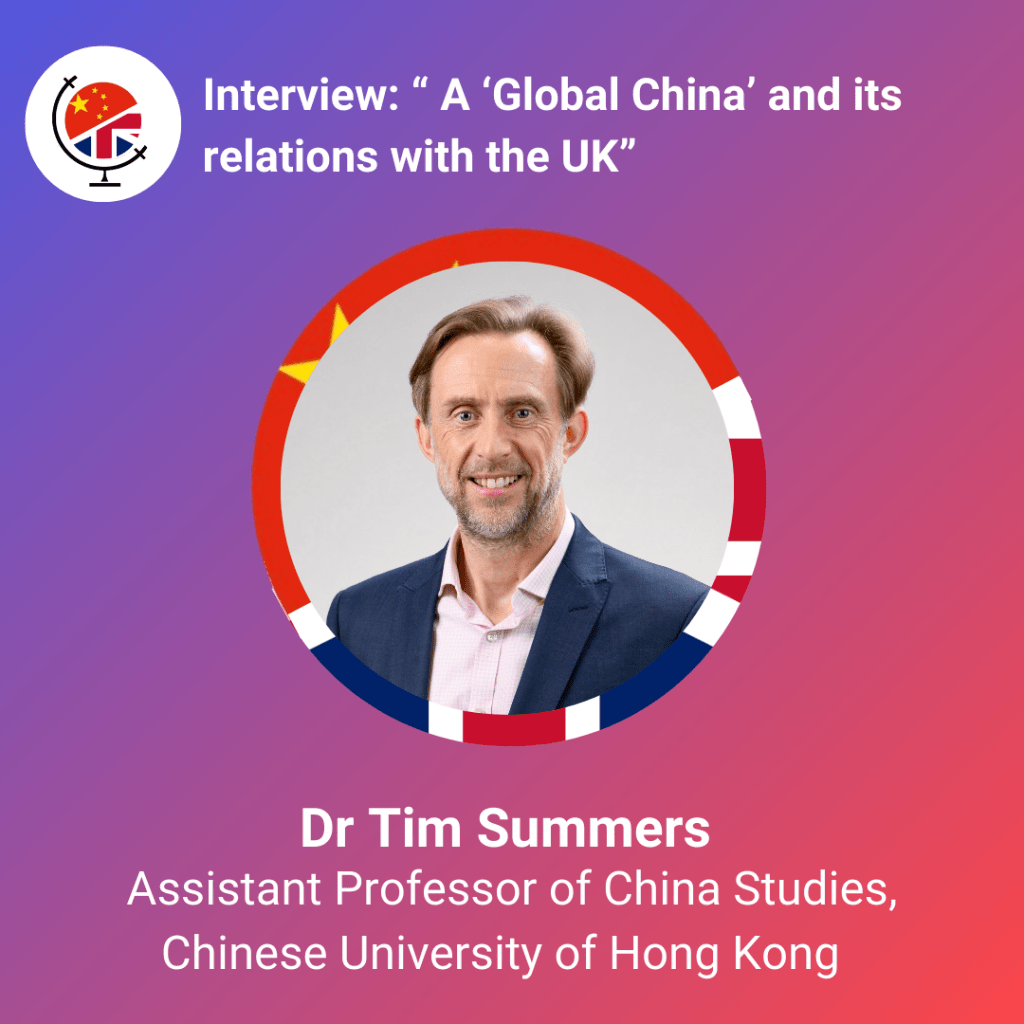
Dr Tim Summers is an assistant professor and the MA programme director at The Chinese University of Hong Kong’s Centre for China Studies. Dr Summers’ research focuses on the international relations and political economy of China. Dr Summers is also an affiliate of the Lau China Institute at King’s College London, was previously a non-resident fellow at Chatham House, and served as a British diplomat at various posts in China including as Consul-General in Chongqing. His latest book, ‘Global China: A Critique of Chinese and Western Narratives’, delves into the conceptual understanding of China in political discourse and academia. In our interview, we discussed Dr Summers’ work on the UK’s evolving strategic approach to China and the broader region amidst global political strife, as well as the arguments of his latest books.
In a recent article you identified how the UK’s global strategy is attempting to engage more with Asia but disengage with China. Is there a way for the UK to navigate that contradiction?
The UK’s tilt towards the Indo-Pacific under the previous government was driven by several reasons, primarily economic drivers as economies in the region grew and became more important, but also security drivers, which are a response to fears about China’s growing global influence. The tilt was also driven by values, according to the UK’s strategy, such as committing to supporting free trade in the region and engaging with regional groupings like CPTPP. However, the strategy missed the central role of China in the Indo-Pacific, both its enormous economic size and also its role in leading regional integration and projecting influence across the region as a whole.
I think the contradiction, in a sense, can’t be resolved without a more pragmatic engagement with China, both directly and also indirectly in the wider region. At the outset of the Belt and Road Initiative (BRI) in the mid-2010s, the UK said it wanted to engage with China through the BRI in third countries in the region. However, I think that dynamic is somewhat missing from the UK’s current approach. It’s worth saying that our article on this only looks at the strategy up until the 2024 election, but I have not yet seen a significant change under the Labour government.
Can the UK pragmatically engage with China despite the security imperatives driven by the US?
I think to change the approach to China fundamentally would require an incredible effort and would need a big change from the political establishment and the ecosystem around it in the UK. There have always been critics of the UK’s closeness to the US and reliance on the US in the defence sector, but they have been fringe voices. But the UK’s defence is operationally very deeply embedded with the US, and to move away from the US practically or psychologically would be very difficult.
There could be more acknowledgement, however, from the UK that the country’s security interests in the Indo-Pacific are different from the US’s. This is also something European countries could do, to stress that they have different priorities from the US, which wants to maintain its position as the global power. There ought to be a starting point for the UK’s policies which acknowledges that difference.
This is not just an issue under Trump; during Brexit some people said that the UK would have to get closer to China, but in the end it got even closer to the US. There are many restrictions, not just economic and military, but also domestic political pressures. We now have a US which is much more aggressive in pursuing its interests and is happy to use leverage against its allies to push them in a certain direction, for example, on their security stance towards China. Another example of dependence on the US is in investment: Chinese investment in the UK is very low compared to the US, which is deeply integrated with our basic economy and society.
You have also studied UK-China academic relations in your work. Could you first reflect on the UK policies since your article in 2023 and their impact on UK-China academic relations?
I haven’t done systematic work on this issue since the article, but I don’t think the policy framework has moved that quickly in relation to this issue since then. There has been a gradual shift through the National Security Act and the new government advisory body on this issue, but it is a subtle securitisation of academic ties. Outside of the government, political voices have continued to up the ante: – for example, a recent article on UK universities that allegedly work with the Chinese military. The issue has become more politicised, but the policy approach hasn’t changed much.
However, many UK universities still want to work closely with China, and the government recognises that this is an important relationship for those universities, and to cut them off at the knees would be counter-productive. Although I think relations in this area are being securitised, this is a gradual process and will hopefully remain stable. Some academics looking at this issue are exploring concepts such as ‘research security’, helping us to think of ways of balancing risks and opportunities in these relationships. Finally, I do think that in the general discussion on this there is too much focus on the risks rather than the benefits of this cooperation, and this aspect needs to be emphasised more.
Many UK universities rely partially on fees from Chinese international students. Is this relationship another part of China’s overcapacity, and what are the implications of this reliance of UK universities on Chinese students, especially considering the political context?
There are currently many students graduating from universities in China today; I think the most recent figure was 11 or 12 million undergraduates in China per year, and the majority of Chinese students coming to the UK are coming for master’s courses. Perhaps with other changes globally, the US has become less appealing for Chinese students; the UK is relatively more in demand now. This relationship should be celebrated, and the UK should use this opportunity to introduce Chinese students to the West and different ways of thinking. However, on the UK end there is clearly an aspect of the university model requiring subsidisation through international students. In one of our recent articles, we looked at the numbers of student visas being issued, and India recently surpassed China, with other markets on the rise too. So there’s clearly a diversification away from overreliance on China, due to fears that China could use that position as leverage, which I can understand. I think the real solution actually might be looking anew at the funding model and financial sustainability of UK universities.
To what extent have UK-China relations been impacted by shifts in the structure of the world economy away from global free trade?
In these cases it’s difficult to distinguish between cause and effect, but looking at a 20-year period of UK-China relations, you do see a notable shift in the ideology of the UK. 20 years ago the rhetoric of the UK was about being open to the world, and anyone could buy assets in the UK; it was ‘nationality blind’. Nowadays you’re seeing more securitisation in this relationship, with potential screening processes for investment deals, and the government has intervened in a few high-profile cases. The numbers overall might be small, and the UK might remain quite an open economy, but there has been a shift driven by concerns about relations with China. People looking to invest now think twice before investing in a way they may not have done before. In general it’s a much more politically charged environment for trade and investment. You could say that we in Europe have become more like China in that regard, securitising our economy, but then China has also become continually more open since the 1990s as it has integrated with the world economy.
There has been the rise of the term ‘Global China’ in academia on China and its international relations. Could you summarise the idea of ‘Global China’ and why it is important?
You’re right to say it’s difficult to define; for many it means China’s manifestations outside its borders. But I was inspired by Franceschini and Loubere’s ‘Global China as Method’ in writing my book, which encourages us to think about China differently, as integrated into the world. One of the main arguments of my book is that China is understood best by looking into the ways in which it is related to and integrated with the rest of the world. Yet, at the same time, China’s political economy and society have distinctive elements, and there is a ‘will to difference’, so there is a balance between these two positions.
There is a certain amount of literature that says that China is just another part of global capitalism, and you can understand China by looking at the global capitalist system, which the Franceschini and Loubere book gets close to at times. At the other end there are a lot of people that say China is completely sui generis, and I am trying to position myself in the middle of that, arguing that China should be understood more through how it is connected to the world but also at the same time recognising the distinctiveness of China and the desire to be different despite there being similarities.
What can the rise of the ‘Global China’ movement tell us about the nature of international relations in the current day?
Another feature of ‘Global China’ is thinking of China as a risen power, rather than a rising power. Then the questions are not so much how will China interact with the world order, but how is it currently participating in the international system. All of these questions involve debates as to the current state of world order, but we are probably in a world order that is neither unipolar nor bipolar. So, we need to create some new models to interpret the world order, and we need to start by looking at China as a significant part of the world and the world order.
Another aspect is looking at the interests and goals of China itself in the world order. China doesn’t want to impose itself on the world order, but it does want to take a leading role, and we’re seeing this through their four global initiatives on civilisation, development, security, and global governance, and the idea of a community of shared future. I look at this final idea in the book as a way to view Chinese interests in the world order today and how they would like to take agency in the international system.
Thinking about the intellectual origins of your book ‘Global China’, particularly the influence of historian Arif Dirlik, where do you think the ‘Global China’ concept could go next?
First of all, I recommend Arif Dirlik’s works, and I think the idea of China being interconnected with the world is a big theme of his, and therefore ‘Global China’ isn’t really a new idea. There’s a worry that the term ‘Global China’ becomes a bit of a slogan that looks attractive but doesn’t develop any coherence beyond obvious truisms like ‘China is part of the world’ and ‘China can’t be separated from the world’. However, I think a lot of those obvious points still need to be made, because there is a tendency for some to think that China is totally different and disconnected from anywhere else, and I don’t think that is accurate. There are a lot of commonalities, and we need to look closer at them – both the economic interconnectedness and the broader human commonalities that we share.
If the term ‘Global China’ can point us towards that sense of connectedness and common interest, whilst at the same time recognising the pluralism, then it is a good thing. I’m not a pluralist in the way you might see Chinese thinking in the Global Civilisation Initiative, but I’m a pluralist in the sense of recognising the diversity and the sense of different values in different places and points in time. All of this is difficult to conceptualise or talk about clearly, but if ‘Global China’ can prompt us to think in a more complex way about the interconnectedness of the world, then it will have some utility.
 UK Forum on a Multipolar World
Leave a comment